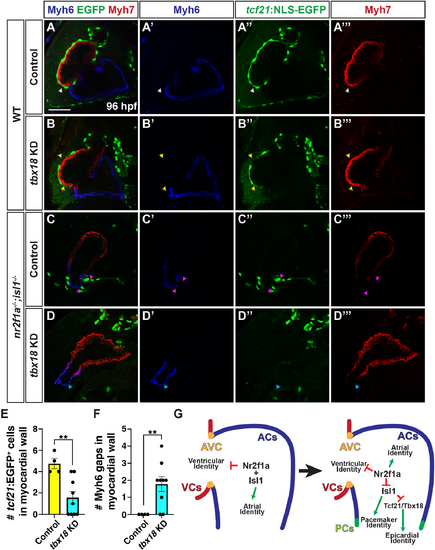
tbx18 is required to promote epicardial cell gene expression in nr2f1a;isl1 mutant atria. (A-D‴) Optical sections of immunohistochemistry for Myh6 (blue), Myh7 (red) and tcf21:NLS-EGFP (green) in control and tbx18 knockdown (KD) wild-type and nr2f1a−/−;isl1−/− hearts. (A-A‴) Epicardial cells (ECs) on the ventricle (white arrowheads). (B-B‴) The lack of ECs on the ventricle (yellow arrowheads). (C-C‴) tcf21:NLS-EGFP+/Myh6− cells in myocardial wall (magenta arrowheads). (D-D‴) Gaps in Myh6 within the myocardial wall (blue arrowheads). Scale bar: 25 μm. Control: WT (n=4) and nr2f1a−/−;isl1−/− (n=4); tbx18 KD: wild type (n=9) and nr2f1a−/−;isl1−/− (n=22). (E) Quantification tcf21:NLS-EGFP+ cells within the hearts of control and tbx18 KD nr2f1a−/−;isl1−/− embryos. **P=0.0017 (two-tailed Welch's t-test). (F) Quantification of gaps in Myh6+ myocardial wall of hearts from control and tbx18 KD nr2f1a−/−;isl1−/− embryos. **P=0.0035 (two-tailed Welch's t-test). (G) Model indicating functional interactions of Nr2f1a and Isl1 within the zebrafish heart. Initially, Isl1 augments Nr2f1a maintenance of atrial cardiomyocyte (AC) identity. Subsequently, Nr2f1a and Isl1 have opposing roles within the venous atrium, with Nr2f1a promoting working AC identity and Isl1 promoting atrial cardiomyocyte identity. In the absence of both Nr2f1a and Isl1, ACs fail to maintain identity and transdifferentiate into ECs via Tcf21 or Tbx18.
|
