
Figure 6
- ID
- ZDB-FIG-250325-41
- Publication
- Ravel et al., 2025 - Modeling zebrafish escape swim reveals maximum neuromuscular power output and efficient body movement adaptation to increased water viscosity
- Other Figures
- All Figure Page
- Back to All Figure Page
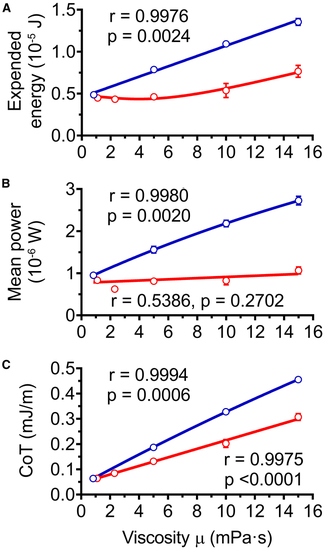
Energetic performances of zebrafish EFP-induced escape response according to increasing experimental and Energetic parameters were quantified after an experimental increase of viscosity using body movements recorded in media of 0.83–15 mPa⋅s (red lines). For comparison purposes, the same parameters were assessed after computational enhancements of viscosity up to 15 mPa⋅s by using body movements recorded in water (0.83 mPa⋅s) as input data (blue lines). (A) Total expended energy over six tail bend/beat cycles was not constrained. Experimental data-based simulations (red lines) showed no statistically significant change in total expended energy at viscosities lower than 10 mPa⋅s, and that the relation between expended energy and viscosity was not linear ( (B) Mean power was not statistically significantly affected by actual experimental increases in viscosity. Experimental viscosity simulations (red line) showed no significant correlation between power and viscosity, and slope was not significantly different from zero. In contrast, the slope of the virtual viscosity simulations (blue line) was significantly different from zero and the corresponding Pearson correlation test was significant. Coefficient of determination was R2 > 0.99 for the virtual viscosity linear regression. (C) CoT was significantly affected by experimental differences in viscosity ( |