
Figure 8
- ID
- ZDB-FIG-250325-43
- Publication
- Ravel et al., 2025 - Modeling zebrafish escape swim reveals maximum neuromuscular power output and efficient body movement adaptation to increased water viscosity
- Other Figures
- All Figure Page
- Back to All Figure Page
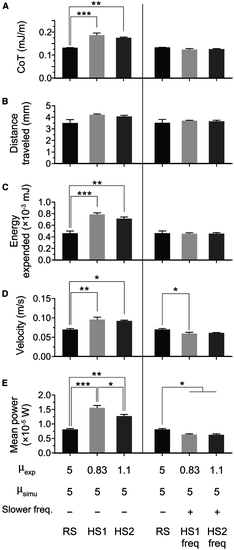
Energetic and kinematic analysis of EFP-induced escape response swimming performances of realistic simulations based upon recordings in μ = 5 mPa⋅s compared to simulations based upon recordings in μ = 0.83 or 1.1 mPa⋅s followed by virtual increases to 5 mPa⋅s (A–E) Realistic numerical simulations (RS) were obtained from movements recorded in media of 5 mPa⋅s viscosity. Hypothetical simulations were based upon movements recorded in viscosities of 0.83 mPa⋅s (HS1) or 1.1 mPa⋅s (HS2) as input, followed by a computational enhancement of viscosity to 5 mPa⋅s (left panels). Application of a hypothetical 30% decrease in tail bend/beat frequency (respectively HS1-freq, and HS2-freq) resulted in values that closely matched realistic CoT, energy expenditure and distance traveled (right panels). (A) In both HS1-freq and HS2-freq, the 30% frequency reduction brought CoT quite close to the corresponding RS value. Likewise, the hypothetical frequency reduction aligned all three values of distance traveled (B) and total expended energy over six tail bend/beat cycles (C). Swimming velocity (D) and mean power (E) were not aligned by the 30% frequency reduction. Data represented correspond to mean ± SEM of three realistic or hypothetical simulations. Experimental and simulated viscosities, respectively μexp and μsimu, in which fish motions were recorded or virtually computed, are specified as mPa⋅s (bottom panel). Significance of differences in measured parameters was assessed by ANOVA followed by post-hoc Tukey test; ∗ |