Zebrafish Anatomical Dictionary
Structure description: hair cells
by Tanya Whitfield
Name: hair cells
Abbreviation: hc
Synonyms: Sensory hair cells
Figures:
 live neuromasts |
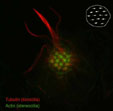 neuromast polarity |
Description: The mechanosensory cell type in the ear and lateral line systems. Hair cells are found in thickened sensory patches, where they sit apically in a pseudostratified epithelium, and are interspersed with supporting cells, which straddle the epithelium. Hair cells have a well-defined apicobasal polarity, with specialised cytoskeletal structures on their apical surfaces. These consist of a bundle of stereocilia, arranged in a stepped array, and a single kinocilium. Stereocilia and kinocilia are embedded in the otolithic membrane (maculae) or a gelatinous cupula (cristae, lateral line neuromasts). Stereocilia vary in number and length, depending on the type of sensory patch. The eccentric location of the kinocilium relative to the stereocilia gives each hair cell a polarity (and thus a particular directional sensitivity) in the plane of the epithelium. Hair cells synapse with afferent and efferent neurons on their basal surfaces.
Homologues:
- Human: sensory hair cells
- Mouse: sensory hair cells
- Chicken: sensory hair cells
- Frog: sensory hair cells
- Fly: no direct counterparts; however, mechanosensory bristles and chordotonal sensilla show structural, functional, molecular and developmental parallels with ertebrate hair cells
Stages:
- First appears at: prim 5 stage (21.5-21h, ear maculae); pec fin stage (60h, ear cristae); long pec stage (48h, lateral line neuromasts)
- Disappears (or changes name) at: Hair cell production is thought to continue throughout adult life in fishes.
Parents (forms from): cranial placodal ectoderm (otic vesicle epithelium, lateral line epithelium); there may also be a small contribution from neural crest (Collazo et al., 1994).
Children:
- Presumptive (thought to give rise to): nothing
- Anlage (known to give rise to): nothing
Group (member of):
- Anatomical (group member): ear, lateral line
- Functional (group member): auditory, vestibular, lateral line systems
Markers:
- mRNA:
- Antibodies:
-
anti-acetylated tubulin (labels kinocilia and neurons)
S100, zn1, zn5, zn15, zns2
Pax2a (Riley et al., 1999) - Other:
-
Vital dyes: DASPEI (2-(4-dimethylaminostyryl)-N-ethyl pyridinium iodide) (Molecular
Probes)
FM1-43 (N-(3-triethylammoniumpropyl)-4-(4-[dibutylaminostyryl) pyridinium dibromide) (Molecular Probes) (Seiler and Nicolson, 1999)
4-Di-2-Asp (4-(4-diethylaminostyryl)-N-methylpyridinium iodide (Sigma D-3418) (Collazo et al., 1994)
Other protein labels: fluorescein- or Alexa phalloidin (labels actin, rich in the stereocilia)
Publications:
- Primary: Haddon, C. and Lewis, J. (1996) Early ear development in the embryo of the zebrafish, Danio rerio. J. Comp. Neurol. 365:113-128.
- Secondary:
-
Collazo,
A., Fraser, S. E., and Mabee, P. M. (1994). A dual embryonic origin for
vertebrate mechanoreceptors. Science 264, 426-430.
Haddon, C., Jiang, Y.-J., Smithers, L., and Lewis, J. (1998). Delta-Notch signalling and the patterning of sensory cell differentiation in the zebrafish ear: Evidence from the mindbomb mutant. Development 125, 4637-4644.
Haddon, C., Mowbray, C., Whitfield, T., Jones, D., Gschmeissner, S., and Lewis, J. (2000). Hair cells without supporting cells: further studies in the ear of the zebrafish mind bomb mutant. Journal of Neurocytology 28, 837-850.
Parichy, D. M., Rawls, J. F., Pratt, S. J., Whitfield, T. T., and Johnson, S. L. (1999). Zebrafish sparse corresponds to an orthologue of c-kit and is required for the morphogenesis of a subpopulation of melanocytes, but is not essential for hematopoiesis or primordial germ cell development. Development 126, 3425-3436.
Riley, B. B., Chiang, M.-Y., Farmer, L., and Heck, R. (1999). The deltaA gene of zebrafish mediates lateral inhibition of hair cells in the inner ear and is regulated by pax2.1. Development 126, 5669-5678.
Seiler, C., and Nicolson, T. (1999). Defective calmodulin-dependent rapid apical endocytosis in zebrafish sensory hair cell mutants. Journal of Neurobiology 41, 424-434.
Comments: None