
Fig. 4
- ID
- ZDB-IMAGE-260924-28
- Genes
- Publication
- Torres-Perez et al., 2026 - Disrupting fzd9b in Zebrafish Recapitulates Stress- and Anxiety-Like Behaviours Relevant to Williams Syndrome
- All Figures
- Figures for Torres-Perez et al., 2026
|
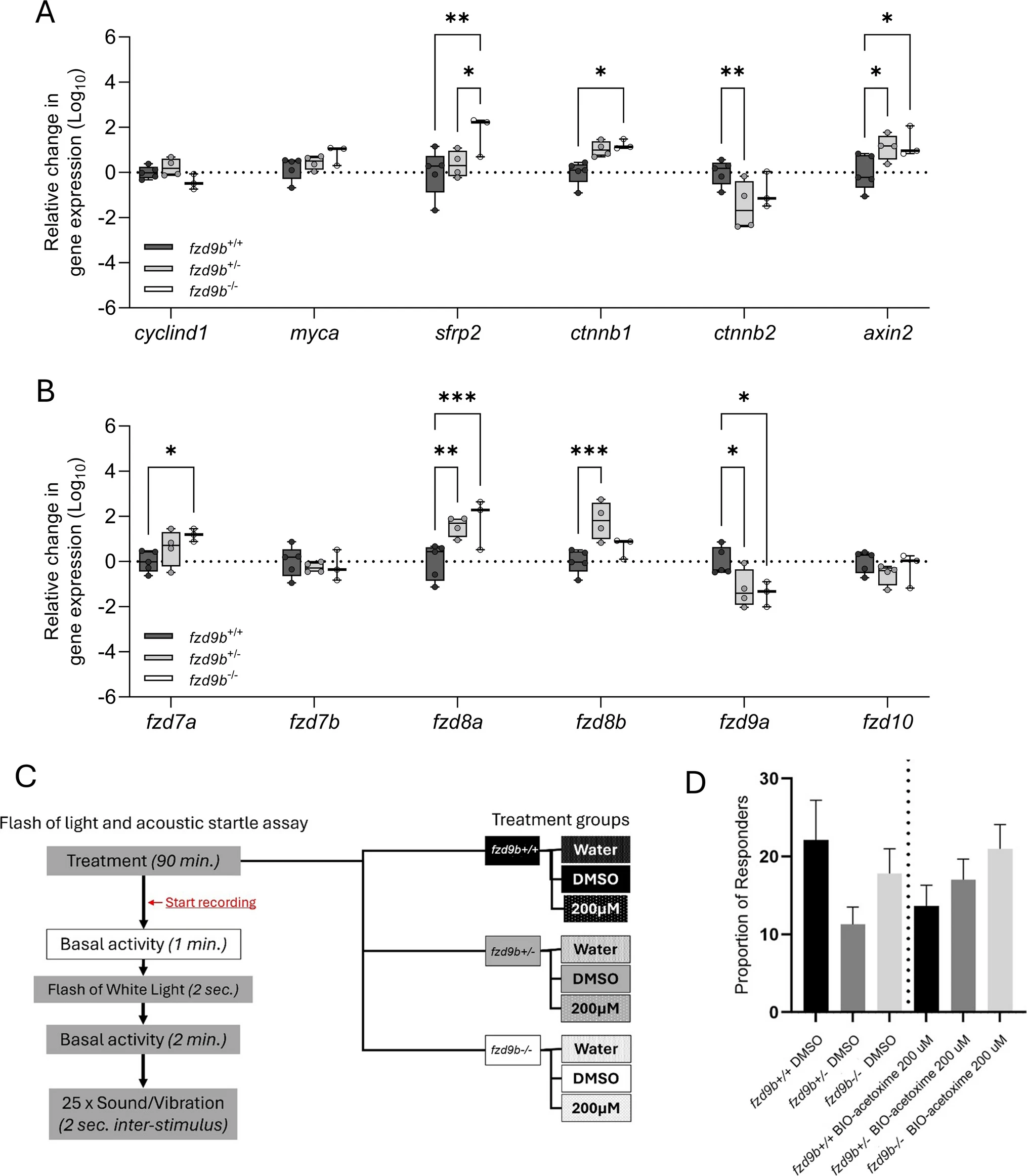
Fig. 4 Wnt pathway expression and behavioural response to BIO-acetoxime in 5 dpf zebrafish. A) Relative gene expression (log₁₀ scale) of Wnt/β-catenin pathway genes (cyclind1, myca, ctnnb1, ctnnb2, axin2, sfrp2) measured by qPCR in pooled 5 dpf larvae (n = 3–5 per genotype; 16 larvae per pool). Graphs show individual values and mean ± SEM. B) Relative gene expression (log₁₀ scale) of other frizzled receptor genes (fzd7a, fzd7b, fzd8a, fzd8b, fzd9a, and fzd10) measured by qPCR (n = 3 per genotype; 16 larvae per pool). Graphs show individual values and mean ± SEM. C) Schematic of the drug treatment and behavioural assay. After 90 min of incubation with BIO-acetoxime (200 μM) in darkness, zebrafish were recorded for 1 min (baseline), exposed to 2 s of white light, followed by 2 min darkness, and then subjected to 25 consecutive acoustic stimuli (2-s inter-stimulus interval). Treatment groups included: fzd9b+/+ (control: water; vehicle: DMSO; drug: BIO-acetoxime), fzd9b+/- and fzd9b−/− (each treated with water, DMSO, or BIO-acetoxime). D) Proportion of responders across stimuli for each treatment condition; each genotype × treatment group included n = 42 larvae; data represent mean ± SEM. * p < 0.05 vs. corresponding pairwise comparison