
Fig. 7
- ID
- ZDB-FIG-220831-22
- Publication
- Picton et al., 2022 - Developmental switch in the function of inhibitory commissural V0d interneurons in zebrafish
- Other Figures
- All Figure Page
- Back to All Figure Page
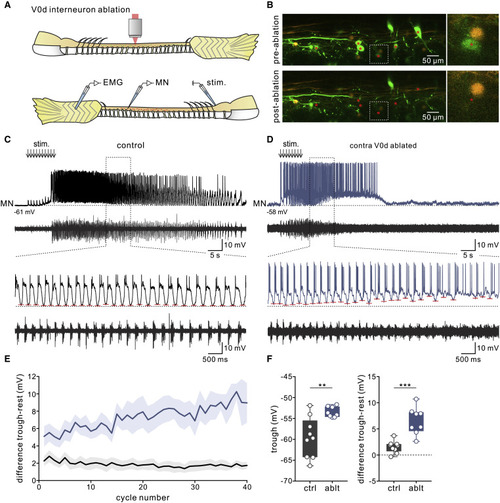
Figure 7. Ablation of V0d interneurons in juvenile zebrafish disrupts mid-cycle inhibition in motoneurons during slow fictive swimming (A) Experimental setup. Top: V0d interneurons were ablated along several segments on one side of the spinal cord. Bottom: recordings were then made from motoneurons on the opposite side of the spinal cord during swimming evoked by electrical stimulation. (B) Image of the spinal cord before (“pre-ablation”) and after (“post-ablation”) two-photon ablation of 20–40 V0d interneurons across approximately 5 spinal cord segments. (C) Recording of a control slow motoneuron during evoked fictive swimming in which mid-cycle inhibition silences motoneuron firing at each swim cycle. (D) Recording of a slow motoneuron during fictive swimming following the ablation of V0d interneurons. The mid-cycle inhibition becomes weaker and motoneuron firing becomes tonic as the swim episode progresses (red dashes indicate the peak of mid-cycle inhibition). (E) Pooled data showing the voltage difference between the trough value of mid-cycle inhibition and the resting membrane potential (mean and SEM; n = 9 control motoneurons from 7 separate animals; n = 8 motoneurons from 7 separate V0d-ablated animals). (F) Following the ablation of V0d interneurons, the value of mid-cycle inhibition in motoneurons became significantly more depolarized compared with control motoneurons (n = 9 control motoneurons from 7 separate animals; n = 8 motoneurons from 7 separate V0d-ablated animals; ∗∗p < 0.01; ∗∗∗p < 0.001; unpaired two-tailed Student’s t test). |