
Fig. 2
- ID
- ZDB-FIG-220831-17
- Publication
- Picton et al., 2022 - Developmental switch in the function of inhibitory commissural V0d interneurons in zebrafish
- Other Figures
- All Figure Page
- Back to All Figure Page
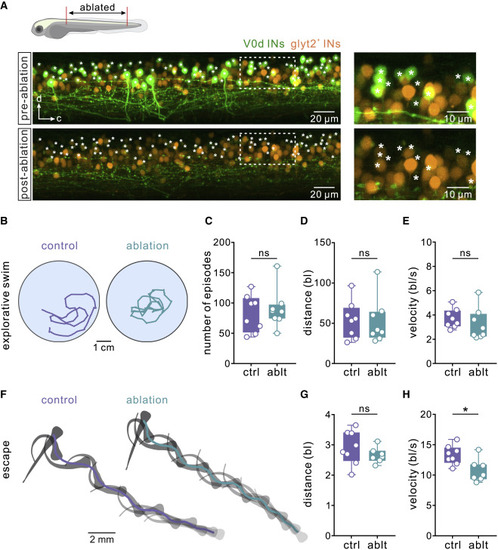
Figure 2. Ablation of V0d interneurons in young larval zebrafish affects escape behavior but not spontaneous swimming (A) Confocal images of the spinal cord of a larval zebrafish (5 dpf) showing V0d interneurons before (“pre-ablation”) and after two-photon laser ablation (“post-ablation”). The panel on the right shows the expansion of the area indicated by a dashed line. V0d interneurons are shown in green and non-V0d glycinergic interneurons in orange. (B) Tracking of spontaneous explorative swimming in vivo in a control larval zebrafish and following the ablation of V0d interneurons. (C) Ablation of V0d interneurons had no effect on the number of spontaneous swim episodes (n = 8 control animals; n = 8 ablated animals; two-tailed Student’s t test). (D) Ablation of V0d interneurons had no effect on the overall spontaneous swim distance (n = 8 control animals; n = 8 ablated animals; Mann-Whitney test). (E) Ablation of V0d interneurons had no effect on swim velocity (n = 8 control animals; n = 8 ablated animals; two-tailed Student’s t test). (F) A sequence of escape and fast swimming evoked by a sound stimulus in control and in a V0d-ablated larval zebrafish. (G) Ablation of V0d interneurons had no effect on escape distance (n = 8 control animals; n = 7 ablated animals; two-tailed Student’s t test). (H) Ablation of V0d interneurons significantly reduced the overall velocity of the evoked escape sequence (n = 8 control animals; n = 7 ablated animals; ∗p < 0.05; two-tailed Student’s t test). See also Figure S1. |