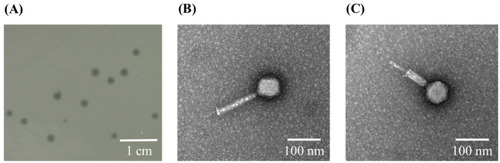
Lytic plaques and morphology of phiLCL12. (A) Clear, round lytic plaques observed when using P. aeruginosa LCL12 as the host strain; scale bar, 1 cm. (B) Transmission electron microscopy (TEM) image of phiLCL12 revealing its morphology, with a head diameter of 71.42 nm and a tail length of approximately 142.85 nm, categorizing it as a long-tailed phage; scale bar, 100 nm. (C) Stretching pattern of the phiLCL12 tail observed using TEM; scale bar, 100 nm.

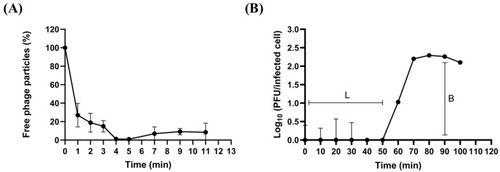
Biological characteristics of phiLCL12. (A) Adsorption assay of phiLCL12 conducted at an MOI of 0.0005 using P. aeruginosa LCL12 as the host. (B) One-step growth curve of phiLCL12 at an MOI of 0.01 in LCL12 culture broth. “L” represents latent time, while “B” denotes burst size. Stability testing of phiLCL12 performed by culturing it at seven different temperatures (C) and five pH levels for 1 h (D). All results are based on three independent experiments. “***” indicates p < 0.001, “**” indicates p < 0.01, “ns” indicates not significant.

Biological characteristics of phiLCL12. (A) Adsorption assay of phiLCL12 conducted at an MOI of 0.0005 using P. aeruginosa LCL12 as the host. (B) One-step growth curve of phiLCL12 at an MOI of 0.01 in LCL12 culture broth. “L” represents latent time, while “B” denotes burst size. Stability testing of phiLCL12 performed by culturing it at seven different temperatures (C) and five pH levels for 1 h (D). All results are based on three independent experiments. “***” indicates p < 0.001, “**” indicates p < 0.01, “ns” indicates not significant.

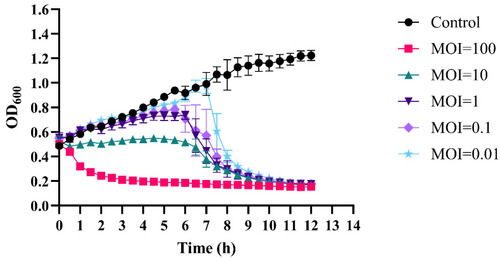
Phage–bacteria growth kinetics at different MOIs. The lytic activity of phiLCL12 against the LCL12 host was evaluated at five different MOIs. Data represent the mean of the measurements recorded every 30 min over a 12 h period, with the standard deviation (SD) indicated using error bars. Each experiment was conducted in triplicate to confirm the reliability of the results.

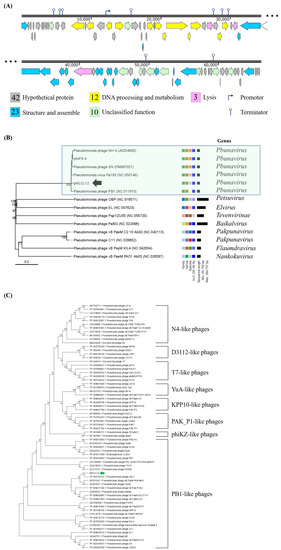
Genome map and phylogenetic analysis of phiLCL12 and related phages. (A) Genome map of phiLCL12, with the numbers inside the boxes representing the open reading frames (ORFs). Using BlastP comparisons of protein products, SnapGene 6.0.2 was used to group the phage genome into functional modules, each displayed in a different color. (B) Phylogenetic tree of phiLCL12, generated through whole-genome analysis and family classification using VICTOR (https://ggdc.dsmz.de/victor.php# (accessed on 28 March 2022)). Different colors represent various genes and species, with darker blue blocks indicating higher GC content. (C) Comparative analysis of terminase proteins from different Pseudomonas phages. The genetic relationships were analyzed using MEGA11, with ClustalW employed for sequence alignment, followed by classification with the Neighbor-Joining algorithm. The bootstrap values from 1000 replicates are shown.

Effect of combining phiLCL12 with different antibiotics. This figure illustrates the effects of phiLCL12 in combination with (A) IMP (imipenem), (B) GM, gentamicin at different MOIs.; N, no antibiotics added; Y, presence of antibiotics. All results were based on experiments performed in triplicate.

Biofilm clearance by combining phiLCL12 and 1/2 MIC of imipenem over time. After 12 h of P. aeruginosa LCL12 biofilm growth at 2 × 10⁷ CFU, varying concentrations of phiLCL12 and 1/2 MIC of imipenem were applied to the experimental groups. (A) Qualitative analysis showed no visible biofilms on the coverslips after 18 h of treatment with 2 × 10⁹ PFU of phiLCL12. Quantitative analysis of biofilm clearance over time, with evaluations conducted at 6 (B), 12 (C), and 18 (D) h. All the results were obtained from three independent experiments. On the left panel, *** represents the significance of the control group versus treated groups assessed by one-way ANOVA, *** indicates p < 0.001. On the right panel, ## and ### represent the significance of the phage-only group versus the PAS group, which is assessed by two-way ANOVA. “###” indicates p < 0.001, “##” indicates p < 0.01.

Inhibition of biofilm formation by combining phiLCL12 and 1/2 IMP at various MOIs. P. aeruginosa LCL12 at 2 × 10⁷ CFU was co-cultured with phiLCL12 at five different multiplicities of infection (MOIs) for 12 h. (A) Qualitative analysis shows effective suppression of biofilm formation on coverslips. (B) The quantitative analysis supports the qualitative results, demonstrating the extent of biofilm inhibition across different MOIs. All results are from three independent experimental replicates. On the left panel, *** is the control group versus the treated groups assessed by one-way ANOVA, “***” indicates p < 0.001. On the right panel, ### is the phage-only group versus the PAS group assessed by two-way ANOVA. “###” indicates p < 0.001.

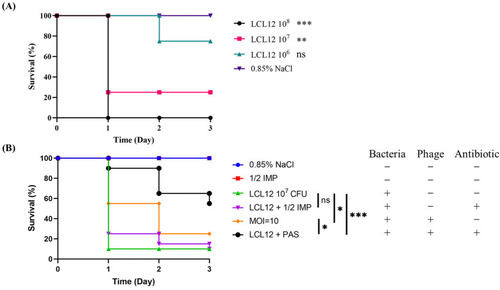
Phage–antibiotic combination therapy outperforms phage therapy alone in zebrafish rescue. (A) Evaluation of toxic responses and determination of the semi-lethal dose (LD50) in zebrafish over 24 h following cloacal injections of three different P. aeruginosa bacterial loads. The results show that an injection of 107 CFU results in the semi-lethal dose being reached within 24 h. (B) Survival rates of zebrafish treated with a combination of phiLCL12 and 1/2 MIC imipenem for 3 days assessed using 107 CFU dose as the semi-lethal threshold. “+” indicates the presence of the indicated treatment or component; “–“ indicates its absence. “***” indicates p < 0.001, “**” indicates p < 0.01, “*” indicates p < 0.05. “ns” indicates not significant.

Acknowledgments
This image is the copyrighted work of the attributed author or publisher, and ZFIN has permission only to display this image to its users. Additional permissions should be obtained from the applicable author or publisher of the image. Full text @ Int. J. Mol. Sci.