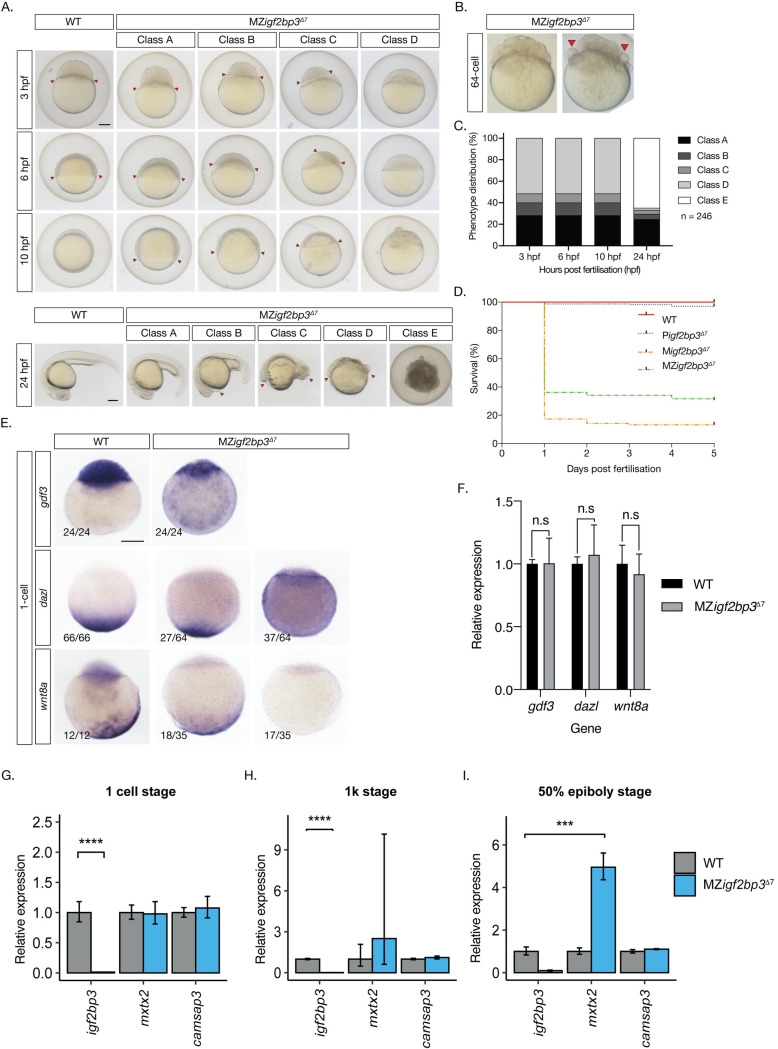
Maternal igf2bp3 is required for normal embryonic development.
A. Maternal igf2bp3Δ7 mutants show severe defects by blastula and gastrula stages. B. At the 64-cell stage, most maternal igf2bp3Δ7 mutants are similar to wild type embryos (left), but a proportion of embryos (right; <15%) show rounded cells (red arrowheads). C-D. The majority of igf2bp3 mutants do not survive beyond 1 dpf. E. Animal-vegetal markers (gdf3, dazl and wnt8a) show altered distribution in igf2bp3Δ7 embryos by whole mount in situ hybridization (WISH). F. qRT-PCRs show that expression levels of gdf3, dazl and wnt8a transcripts is not significantly different from wild type control embryos at the 1-cell stage. G-I. qRT-PCR with maternal igf2bp3Δ7 embryos show that expression of igf2bp3 transcripts is significantly reduced at all stages examined (1 cell, 1K, and 50% epiboly), whereas expression of the yolk syncytial layer (YSL) transcript mxtx2 is initially unchanged (G), but shows variable increase at the 1K stage (F), with substantially higher expression at 50% epiboly compared to controls (I), and the microtubule and spectrin-associated camsap3 transcript is largely unchanged at all stages examined. p ***<0.01 or ****<0.001 from 3 biological replicates. Scale bar in A, 200 μm.
This image is the copyrighted work of the attributed author or publisher, and
ZFIN has permission only to display this image to its users.
Additional permissions should be obtained from the applicable author or publisher of the image.
Full text @ PLoS Genet.
Your Input Welcome
Thank you for submitting comments. Your input has been emailed to ZFIN curators who may contact you if
additional information is required.
Oops. Something went wrong. Please try again later.