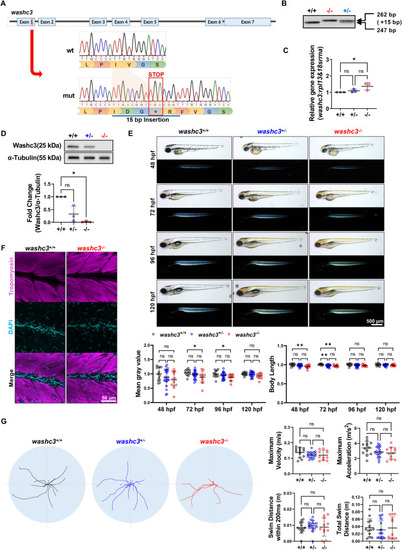
Stable washc3 knockout zebrafish generated via CRISPR/Cas9 editing shows mild skeletal muscle growth phenotype and it is recovered by development. (A) Schematic showing CRISPR/Cas9-mediated gene editing of washc3 exon 1. Sanger sequencing chromatograms are shown with inserted 15 bp causing premature stop codon. (B) RT-PCR analysis confirmed PCR products with or without mutation site in wild-type (wt) siblings (+/+, +/−) and washc3 mutant (−/−). (C) qRT-PCR analysis of washc3 in siblings and washc3 mutant embryos at 72 hpf (SD, n = 3, Kruskal–Wallis test, *p < 0.05 vs. washc3+/+). (D) Immunoblots of Washc3 and α-Tubulin. The blot intensity of Washc3 normalized to α-Tubulin was calculated vs. washc3+/+ (SD; n = 3, Kruskal–Wallis test, *p < 0.05 vs. washc3+/+). (E) Lateral view of siblings and washc3 mutants from 48 hpf to 120 hpf shown in brightfield images (top panel) and birefringence images (bottom panel, scale bar: 500 μm). Statistical analyses showing quantified mean gray value of birefringence intensity (SD; washc3+/+, n = 13; washc3+/−, n = 22; washc3−/−, n = 11; Ordinary one-way ANOVA, *p < 0.05 vs. washc3+/+) and body length (SD; washc3+/+, n = 13; washc3+/−, n = 22; washc3−/−, n = 11; Ordinary one-way ANOVA, **p < 0.005 vs. washc3+/+). Impaired skeletal muscle development of washc3−/− at 72 hpf was alleviated by development (at 120 hpf). (F) IF images of washc3+/+ and washc3−/− stained with Tropomyosin (magenta) and DAPI (cyan) at 96 hpf (scale bar: 50 μm). (G) Overlaid swim traces at 96 hpf from touch evoked escape response assay. Quantification of maximum velocity (m/s), maximum acceleration (m/s2), swim distance within 200 ms (m), and total swim distance (m) didn't show significant difference between siblings and washc3 mutant embryos (SD; washc3+/+, n = 13; washc3+/−, n = 19; washc3−/−, n = 11; Kruskal–Wallis test, ns = not significant vs. washc3+/+).
|
