|
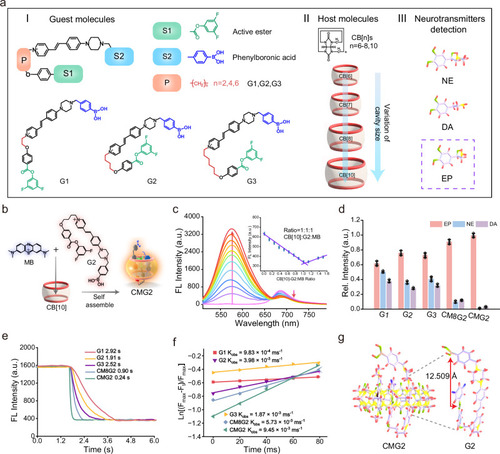
Design and synthesis of host–guest supramolecular fluorescent chemodosimeters for selective and rapid response toward EP. a Schematics of guest recognition molecules G1–G3 with varies alkyl chain lengths, host molecules CB[n]s with different cavity sizes, and neurotransmitters to be tested. b The self-assembly of the developed and optimized CMG2 supramolecular fluorescent sensor for EP. c Fluorescence titration spectra of MB (10 μm) toward addition of CB10-G2 (concentration ratio, 1:1) with different concentration (0−15 μm) in PBS buffer (10 mm, pH = 7.4) containing 0.05% DMSO; Illustration: CB10-G2 with MB assembled molar ratio. Data are presented as mean ± S.D. Error bars: S.D., n = 5 independent experiments. d Interference of G1, G2, G3, CM8G2 and CMG2 on NE and DA (Set the response value of CMG2 for EP to 1.0). Data are presented as mean ± S.D. Error bars: S.D., n = 5 independent experiments. e Kinetic fluorescence responses of the G1–G3 (each 10 μm) and the assembled host-guest supramolecular fluorescent sensor toward addition of 5 μm EP in PBS (10 mm, pH 7.4). f Reaction rate constants (kobs) were measured for the G1–G3 and the assembled host-guest supramolecular fluorescent sensor in response to EP. The pseudo-first-order rate constants (kobs) obtained from the slopes of plot of ln[(Fmax–Ft)/Fmax] vs time. Fmax is the maximum fluorescence intensity during the measurement time, Ft is the fluorescence intensity at the corresponding time points (Fmax, Ft: The fluorescent emission wavelength is 570 nm). g The molecular structure of CMG2 after DFT optimization and the quantification of the distance between two recognition sites of G2. The above-mentioned source data are provided as a Source Data file.
|