
Fig. 7.
- ID
- ZDB-FIG-260522-52
- Publication
- Dockery et al., 2026 - Genes for 5'mRNA cap binding proteins, eif4ea and eif4eb, have alternative roles during heart regeneration
- Other Figures
- All Figure Page
- Back to All Figure Page
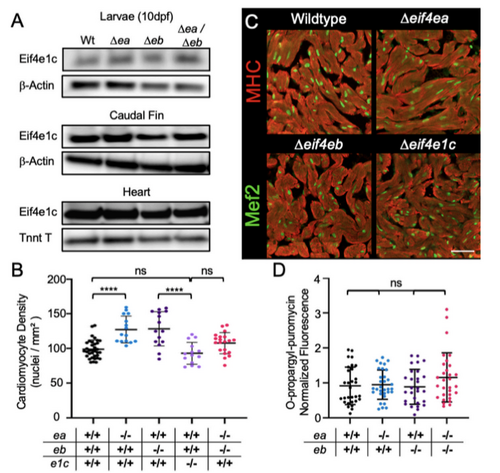
Canonical mutant hearts have slightly enlarged hearts but with similar numbers of cardiomyocytes. (A) Western blots comparing the abundance of Eif4e1c in the different mutants. Whole cell extracts were compared from wildtype, Δeif4ea, Δeif4eb, and Δeif4ea/Δeif4eb siblings. β-Actin was used as a loading control and anti-Troponin was used in the hearts. (B) Representative wildtype and mutant hearts stained for cardiomyocyte nuclei (anti-Mef2c) in green and cardiomyocyte cell bodies (anti-Myosin Heavy Chain) in red. (C) Comparison of cardiomyocyte density (nuclei/mm2) calculated from (B) (Mean: wild type = 98.7,Δeif4ea = 127.3, Δeif4eb = 128.2, Δeif4e1c = 93.0, Δeif4ea/Δeif4eb = 107.5; ANOVA p-value <0.0001; N = 35, 15, 16, 14, 20). (D). Quantification of OPP fluorescence shows no significant difference between mutant and wild-type fish (normalized fluorescence average: wild type = 0.917, Δeif4ea = 0.950, Δeif4eb = 0.889, Δeif4ea/Δeif4eb = 1.16; ANOVA p-value = 0.230; N = 30, 32, 28, 40). Error bars represent mean ± s.e.m. Scale bar = 10um. (For interpretation of the references to colour in this figure legend, the reader is referred to the Web version of this article.) |
| Fish: | |
|---|---|
| Observed In: | |
| Stage: | Adult |
Reprinted from Developmental Biology, 534, Dockery, R., Zevallos, M., McNulty, C., Zecchino, T., Ratermann, R., White, R., Kolonay, D., Baskin, K., Goldman, J.A., Genes for 5'mRNA cap binding proteins, eif4ea and eif4eb, have alternative roles during heart regeneration, 50-60, Copyright (2026) with permission from Elsevier. Full text @ Dev. Biol.