
Fig. 2
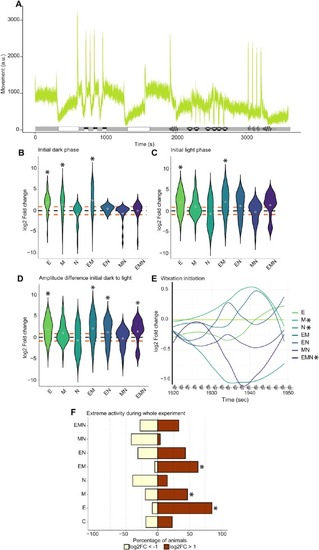
Sensorimotor responses to the Multi-Stimuli Assay (MSA) in 8 dpf larvae prenatally exposed. A. Average locomotor responses of control larvae (C) throughout the duration of the MSA. Movement is presented as pixel difference. B. Average Log2 fold change relative to controls during the initial dark phase. Larvae exposed to ethanol (E), morphine (M), and the combination of both drugs (EM) were hyperactive compared to controls. Nicotine (N)-exposed larvae showed the opposite trend, although it was not statistically significant. C. Average Log2 fold change relative to controls during the initial light phase. Larvae from the E and EM groups displayed hyperactive behaviour. D. Amplitude difference of the log2 fold change following the switch from the first dark phase to the first light phase relative to controls. E-, EM-, EN- and EMN-exposed larvae responded more strongly than controls. E. Repeated vibration exposure leads to habituation and a reduction in response. To determine whether drug-exposed larvae exhibited different habituation rates, we performed a linear mixed-model analysis to assess changes in log2 fold change in response to vibration stimuli. M-exposed larvae showed a significant increase in log2 fold change over time, N and EMN groups displayed a similar initial response that gradually declined over successive pulses. F. The percentage of larvae with an average log2 fold change greater than 1 (dark orange) and lower than −1 (bright yellow) during the whole experiment. A larger proportion of the E- and some of the M- and EM-exposed animals were hyperactive. N and MN-exposed animals had the highest proportion of hypoactive animals, without reaching significance. For B-C-D: * = p < 0.05 compared to controls. Evaluated using mixed-effects models, including Batch as a random effect, followed by Benjamini–Hochberg correction for multiple comparisons. E: * p < 0.05 compared to control animals. P-values were obtained using a linear mixed-effects model with condition over time as a fixed effect and subject (larva ID) and Batch as random effects. F: * = p < 0.05 compared to control animals. P-values were calculated using Firth's bias-reduced logistic regression to compare each treatment to control, followed by Benjamini–Hochberg correction for multiple comparisons. n ≥ 24 per condition. |