
Fig. 3
- ID
- ZDB-FIG-250311-147
- Publication
- Duque et al., 2024 - Ketamine induces plasticity in a norepinephrine-astroglial circuit to promote behavioral perseverance
- Other Figures
- All Figure Page
- Back to All Figure Page
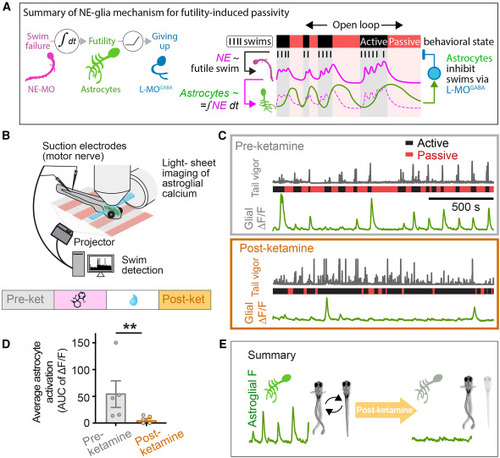
Brief ketamine exposure suppresses subsequent astrocyte calcium responses during futile swimming (A) Summary of mechanism underlying futility-induced passivity in zebrafish, adapted from Mu et al.9 (B) Whole-brain imaging of radial astrocyte calcium during behavior as described in the main text. (C) Swim traces (gray, tail vigor) showing active and passive periods and simultaneously recorded hindbrain astroglial calcium signals from two example Tg(gfap:jRGECO1a) fish either treated with vehicle control (pre-ketamine, top) or ketamine (post-ketamine, bottom). In both cases, fish were allowed to recover for 1 h following washout before recordings were performed. (D) Astrocytes are less active in the open-loop test period after ketamine treatment compared with control, as assessed by comparing the average ΔF/F (area under the curve) of astrocytic calcium after strong-swims before and after ketamine treatment. Mann-Whitney test. n = 5 (pre), 6 (post). p = 0.0087. (E) Summary of findings. Brief ketamine treatment causes, after washout, long-term reductions in passivity and hypo-activation of astrocytes compared with control. |