
Fig. 1
- ID
- ZDB-FIG-250311-145
- Publication
- Duque et al., 2024 - Ketamine induces plasticity in a norepinephrine-astroglial circuit to promote behavioral perseverance
- Other Figures
- All Figure Page
- Back to All Figure Page
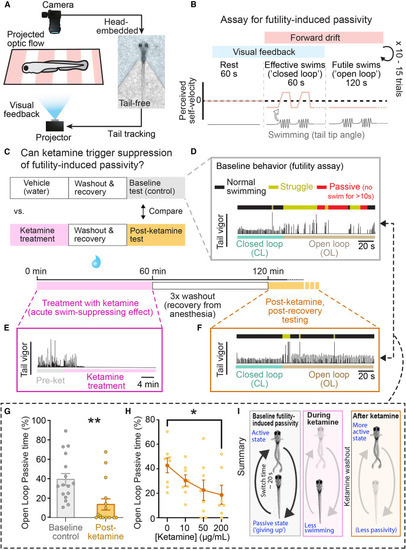
Brief ketamine exposure causes long-term suppression of futility-induced passivity in larval zebrafish (A) Schematic of experimental workflow for imaging swimming behavior in unparalyzed larval zebrafish. (B) Trial structure: 60 s of rest (no stimulus), 60 s of effective swimming (“closed loop,” forward optic flow, visual feedback), then 120 s of futile swimming (“open loop,” forward optic flow, no visual feedback), 10 to 15 repeated trials. (C) Timeline of experiments testing ketamine’s effect on futility-induced passivity. (D) Example trials for vehicle control fish showing tail vigor (rolling-window tail angle standard deviation) across time. Colors above swim trace indicate normal swimming (black), struggle (yellow), and passivity (red). Colors below swim trace indicate closed- (teal) and open-loop (brown) periods. (E) During ketamine treatment, fish tend to become quiescent. (F) After ketamine treatment and washout, example fish swims similarly to vehicle-treated fish in closed loop (cf. D, CL period), but in open loop, they are less passive and more active. (G) Ketamine-treated fish spend less time passive (periods > 10 s with no swimming) than vehicle controls during open loop. Mann-Whitney test, n = 16 fish (control), 15 fish (ketamine), p = 0.0010. (H) Dose-response curve of ketamine’s suppression of open-loop passive time. Mann-Whitney test, n = 8 fish (control), 8 fish (ketamine), p = 0.0289. All error bars denote standard error of the mean (SEM) ∗ p < 0.05 ∗∗ p < 0.01. (I) Summary of findings. |