
Fig 3
- ID
- ZDB-FIG-230407-23
- Publication
- Nelson et al., 2023 - Integration of cooperative and opposing molecular programs drives learning-associated behavioral plasticity
- Other Figures
- All Figure Page
- Back to All Figure Page
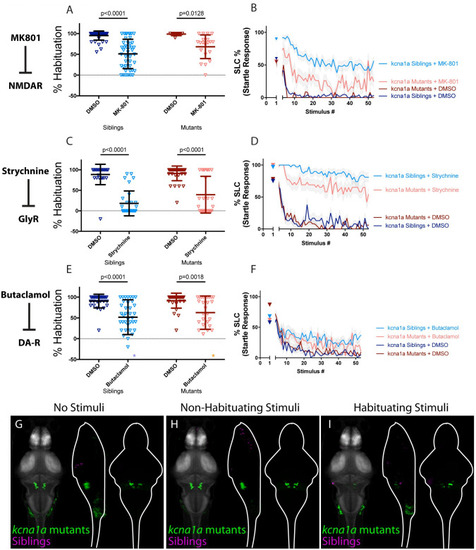
(A-B) MK-801 significantly enhances habituation learning deficits in kcna1a mutants and siblings (p<0.0001, n = 42 DMSO-siblings, n = 46 MK-801-siblings, p = 0.0128, n = 8 DMSO-mutants, n = 20 MK-801 mutants, p = 0.2628 indicates non-significant interaction between drug treatment and genotype). (C-D) Strychnine significantly enhances habituation learning deficits in kcna1a mutants and siblings (p<0.0001, n = 24 DMSO-siblings, n = 31 Strychnine-siblings, p<0.0001, n = 35 DMSO-mutants, n = 26 Strychnine-mutants, p = 0.1063 indicates non-significant interaction between drug treatment and genotype). (E-F) Butaclamol significantly enhances habituation learning deficits in kcna1a mutants and siblings (p<0.0001, n = 30 DMSO-siblings, n = 37 Butaclamol-siblings, p = 0.0018, n = 30 DMSO-mutants, n = 27 Butaclamol-mutants, p = 0.3942 indicates non-significant interaction between drug treatment and genotype). *indicate a sibling+butaclamol and a mutant+butaclamol individual with % hab values below y-axis limit at -100% and -60% respectively. (G-I) Regions upregulated in kcna1a mutants are indicated in green; regions downregulated in kcna1a mutants are indicated in magenta. In all images, the left panel is a summed z-projection of the whole-brain activity changes. The middle panel is a summed x-projection of the whole brain activity changes. The right panel is a z-projection of the analyzed MAP-map. We observed similar patterns of neuronal activity induced by “no stimuli” vs “non-habituating stimuli” vs. “habituating stimuli”: highly restricted upregulation of activity in the spiral fiber neuron clusters as well as in V2A (including Rom3) neurons. See also S1–S3 Tables for ROIs up- and down-regulated in each condition, as well as in independent replicates. |