
Fig 1
- ID
- ZDB-FIG-230407-20
- Publication
- Nelson et al., 2023 - Integration of cooperative and opposing molecular programs drives learning-associated behavioral plasticity
- Other Figures
- All Figure Page
- Back to All Figure Page
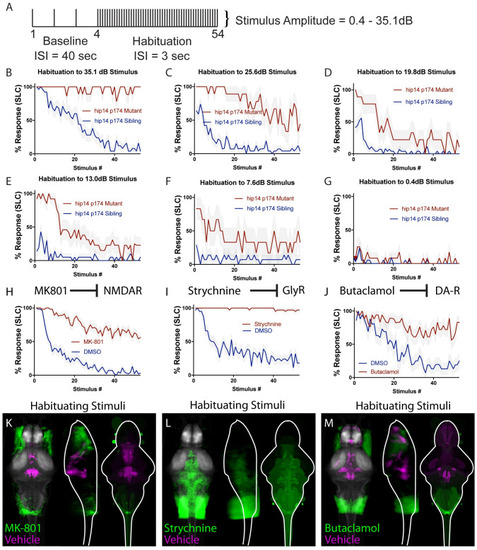
(A) Stimulus paradigm used. ISI for baseline phase is 40 seconds, ISI for habituation phase is 3 seconds. (B)hip14 mutants exhibit a complete failure to habituate to 35.1 dB acoustic stimuli. (C-G) Reduction in stimulus intensity as indicated results in a gradual increase in the ability of hip14 mutants to habituate. (H) MK-801 is an NMDA inhibitor that strongly reduces habituation learning in 5-day old zebrafish larvae (n = 58 DMSO-treated, n = 57 MK-801-treated, stimulus intensity = 35.1dB). (I) Strychnine is a glycine receptor antagonist that strongly reduces habituation learning in 5-day old zebrafish larvae (n = 38 DMSO-treated, n = 38 Strychnine-treated, stimulus intensity = 35.1dB). (J) Butaclamol is a dopamine inhibitor that strongly reduces habituation learning in 5-day old zebrafish larvae (n = 16 DMSO-treated, n = 18 Butaclamol-treated, stimulus intensity = 35.1 dB). (K-M) Regions upregulated by the specified drug treatment under “Habituating Stimuli” conditions are indicated in green; regions upregulated in the vehicle (can also be interpreted as downregulated in drug-treated) are indicated in magenta. In all images, the left panel is a summed z-projection of the whole-brain activity changes. The middle panel is a summed x-projection of the whole brain activity changes. The right panel is a z-projection of the analyzed MAP-map. Molecular targets of pharmacological agents are indicated with diagrams above each column. See S1 Fig for brain activity maps under “No Stimulus” condition and “Non-Habituating Stimuli” condition. Also see S1– S3 Tables for ROIs identified in the experiments presented as well as in an independent replicate of each drug condition. |