
Figure 8
- ID
- ZDB-FIG-260530-209
- Publication
- Mencacci et al., 2026 - Pathogenic variants in BORCS5 Cause a Spectrum of Neurodevelopmental and Neurodegenerative Disorders with Lysosomal Dysfunction
- Other Figures
- All Figure Page
- Back to All Figure Page
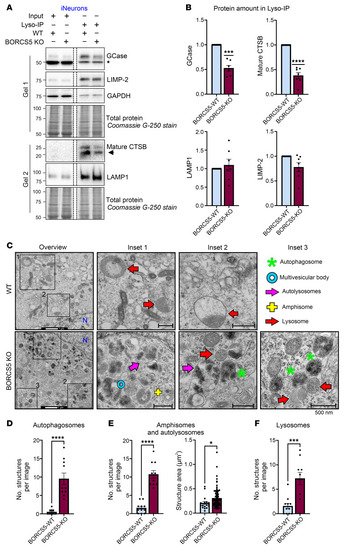
BORCS5 deficiency leads to lysosomal dysfunction in iNeurons. (A) Endolysosomal fractions were enriched from day 21 iNeurons expressing TMEM192-GFP-3xHA via magnetic immunopurification (Lyso-IP). Western blots of samples of the same experiment that were run in 2 different gels, with dashed lines reflecting that samples were loaded in different parts of the same gel, shown with the same exposure. Total protein was monitored by Coomassie G-250 staining of the gel after transfer. The * indicates an unspecific band at 50 kDa, and the arrow indicates the CTSB band quantified during Western blot analysis. (B) Graphs show the mean ± SEM of the relative protein amount normalized to the total protein, 1-sample t test, 7 independent experiments. ***P = 0.0001, ****P < 0.0001. (C) TEM images show the overview and magnified insets of the perinuclear cytoplasm from control and isogenic BORCS5 KO iNeurons. Individual autophagic and endolysosomal structures were classified based on morphological criteria. Scale bar: 1 μm (left panels), 500 nm (enlarged inset panels). (D–F) The number and/or area of the indicated structures are presented as mean± SEM obtained from 10–11 different cells per genotype. Unpaired t test. *P = 0.041, ***P = 0.0004, ****P < 0.0001. |