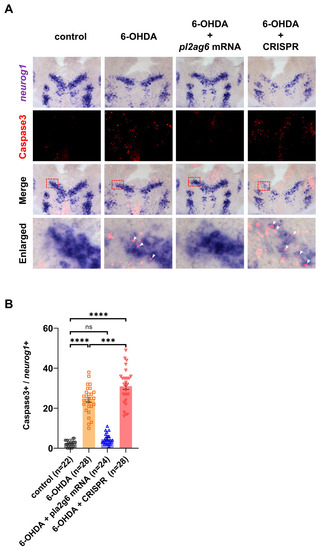
pla2g6 modulates ROS-induced neuronal apoptosis during zebrafish embryogenesis. The effects of oxidative stress and pla2g6 manipulation on neural progenitors and neuronal precursors were examined during zebrafish embryonic development. ROS exposure induces apoptosis in the developing nervous system. Embryos treated with 6-hydroxydopamine (6-OHDA) exhibited increased cleaved caspase-3-positive cells within neurog1-positive region compared with untreated controls. To assess the protective role of Pla2g6, one-cell stage embryos were injected with pla2g6 mRNA and subsequently exposed to 6-OHDA. (A) Dual labeling via neurog1 in situ hybridization and Caspase-3 immunostaining revealed that pla2g6 overexpression significantly attenuated neuronal apoptosis compared to ROS-treated controls. Transient CRISPR/Cas9-mediated disruption of pla2g6 increased Caspase3-positive cells following ROS exposure, suggesting that Pla2g6 deficiency sensitizes cells to oxidative stress. Higher-magnification views of the boxed regions are presented in the bottom rows (red dashed rectangles), with white arrowheads marking caspase-3-positive signals. (B) Quantification was performed by manually counting apoptotic cells within the neurog1-positive region. Data represent three independent biological replicates, with 7–10 embryos per group. Individual data points correspond to cell counts obtained from each embryo. Data are shown as mean ± SEM. Statistical significance was determined using one-way ANOVA with Tukey’s pairwise comparison; ***, p < 0.001; ****, p < 0.0001; ns, not significant.
|
