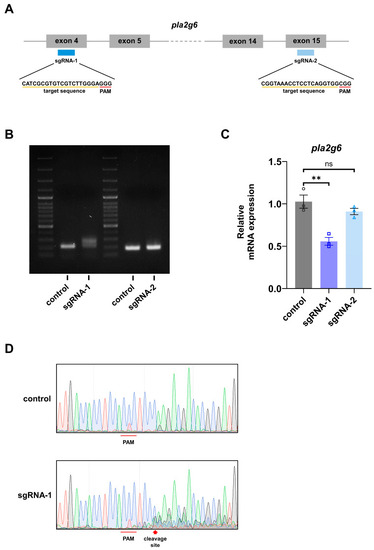
Transient CRISPR/Cas9-mediated disruption of endogenous pla2g6 in zebrafish embryos. (A) Schematic illustration of the zebrafish pla2g6 genomic locus showing the positions and sequences of two independent single-guide RNAs (sgRNAs) targeting non-overlapping regions of the coding sequence. (B) PCR analysis of genomic DNA from zebrafish embryos confirmed targeting of the pla2g6 locus. Embryos injected with sgRNA-1/Cas9 displayed a characteristic smear in gel electrophoresis, whereas the sgRNA-2 group showed a single intact band indistinguishable from controls, indicating that sgRNA-1 efficiently induced a heterogeneous population of insertions and deletions (indels) via CRISPR/Cas9-mediated mutagenesis. (C) Quantitative RT-PCR analysis showed a significant reduction in pla2g6 transcript levels in embryos injected with sgRNA-1/Cas9 compared with controls, whereas no reduction was observed in embryos treated with sgRNA-2. Relative mRNA expression was quantified by qRT-PCR and normalized to gapdh. (D) Sanger sequencing chromatograms of PCR-amplified target regions from control and sgRNA-1/Cas9-injected embryos. Control embryos show uniform sequence traces, whereas sgRNA-1/Cas9-injected embryos display mixed and overlapping peaks downstream of the predicted cleavage site, consistent with heterogeneous indel formation in F0 embryos. Green, red, blue, and black peaks represent “A”, “T”, “C”, and “G”, respectively. Data represent three independent biological replicates with each analyzed in three technical repeats to ensure measurement precision. Data are presented as mean ± SEM. Statistical significance was determined using one-way Analysis of Variance (ANOVA) with Tukey’s pairwise comparison; **, p < 0.01; ns, not significant.
|
