
Fig. 2.
- ID
- ZDB-FIG-260518-24
- Publication
- Brown et al., 2026 - Enhancer-directed gene delivery for digit regeneration based on conserved epidermal factors
- Other Figures
- All Figure Page
- Back to All Figure Page
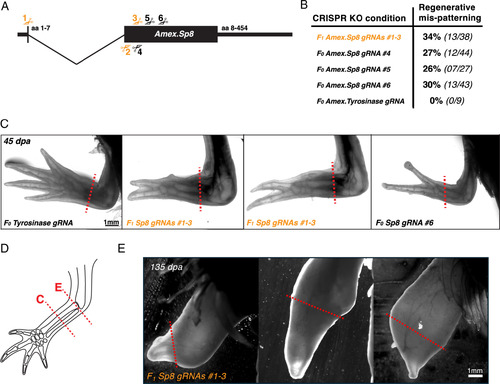
Amex.Sp8 is dispensable for axolotl limb development, but required for limb regeneration. (A) Schematic of Amex.Sp8 genomic locus with 5′/3′ UTRs, 2 exons, and intron. Six CRISPR/Cas guide RNAs (gRNAs) are shown relative to their target on 5′ coding (Top) or 3′ noncoding (Bottom) strand. Amex.Sp8 gRNAs 1 to 3, labeled in gold, were injected together in axolotl embryos and raised to F1 hemizygous larvae. (B) Table summarizing the proportion of axolotls with regeneration-specific limb mispatterning. All axolotls displayed normally patterned limbs prior to amputation at mid-radius/ulna level. Age matched F0 CRISPR/Cas Tyrosinase (Amex.Tyr) knockout axolotls were used as a negative control for proper regeneration. (C) Representative images of limb regenerates in control F0 Amex.Tyr CRISPR KO animals (Left panel) and F1 and F0 Amex.Sp8 KO larvae axolotls at 35 dpa. Amputation planes are indicated by red dashed lines. (Scale bar, 1 mm.) (D) Cartoon representation of primary amputation planes represented in (C), and secondary amputations with resulting regenerates reported in (E). (E) Secondary regenerates from F1 Amex.Sp8 animals amputated just distal to the elbow. Secondary amputations for tissue harvesting were performed approximately 115 d after the primary amputations in (C). Images were taken 135 d post–secondary amputation. (Scale bar, 1 mm.) |