
Fig. 11
- ID
- ZDB-FIG-260402-23
- Publication
- Torres-Martínez et al., 2026 - Triploidy alters hormonal and paracrine signaling to promote male development in zebrafish
- Other Figures
- All Figure Page
- Back to All Figure Page
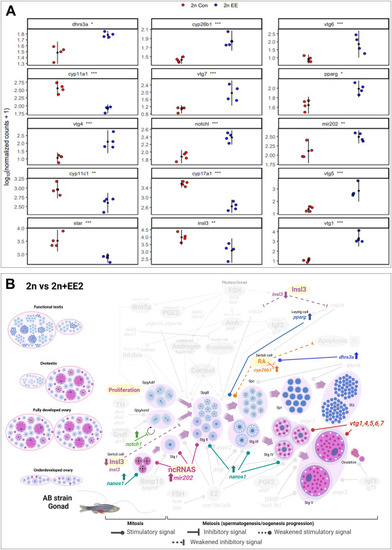
17α-ethinylestradiol (EE2) induce regulatory changes in diploid zebrafish gonads (A). Diferentially expressed genes in EE2-treated diploid (2n + EE2) zebrafish gonads compared to the diploid controls (2n) based on RNAseq. Differentially expressed genes dehydrogenase/reductase member 3a (dhrs3a), cytochrome P450 family 26 subfamily B member 1 (cyp26b1), vitellogenin 6 (vtg6), cytochrome P450 family 11 subfamily A member 1 (cyp11a1), vitelogenin 7 (vtg7), peroxisome proliferator-activated receptor gamma (pparg), vitellogenin 4 (vtg4), neurogenic locus notch homolog protein 1 (notch1), microRNA-202 (mir202), cytochrome P450 family 11 subfamily C member 1 (cyp11c1), cytochrome P450 family 17 subfamily A member 1 (cy17a1), vitellogenin 5 (vtg5), steroidogeneic acute regulatory protein (star), insulin-like growth factor 3 (insl3), vitellogenin 1 (vtg1). Asterisks denote significant differences between treatments. Normalized counts and statistical significance were obtained using DESeq2 median of ratios normalization and negative binomial differential expression modeling. (B) Inferred gene regulatory network in the gonads in the gonads of 2n + EE2 zebrafish at 120 days post-fertilization compared with 2n controls. The left panel (A–D) shows the diverse gonadal outcomes observed after EE2 administration, including ovaries, testes, ovotestes, and abnormal gonads. The right panel illustrates the gene regulatory networks underlying ovarian and testicular differentiation in gonads that exhibited a hermaphroditic stage. EE2 administration altered multiple pathways, notably disrupting retinoic acid catabolism through cyp26b1 and dhrs3a. mir202 emerged as a key ovarian-promoting factor, which, together with decreased insl3 expression, may have been sufficient to induce ovarian development in some individuals. The upregulation of notch1, nanos1, and several vitellogenins (vtg1, vtg4-7) further reflects the feminizing effects of EE2 on the gonads. Upward/downward arrows indicate up- or downregulation of the adjacent gene; colored solid lines represent upregulation, colored dashed lines downregulation, and grey lines genes not differentially expressed but active in baseline gonadal physiology. Line endings denote stimulatory or inhibitory interactions. Abbreviations: spermatogonia An undifferentiated (SpgAund), spermatogonia A differentiated (SpgAdiff), spermatogonia B (SpgB), spermatocyte (Spc), spermatid (Spt), spermatozoa (Stz). The stages of oogenesis in zebrafish are denoted as Stg I to Stg V. Created in BioRender. MARTINEZ, A. (2025) https://BioRender.com/q3sjavl. |
Reprinted from Molecular and Cellular Endocrinology, , Torres-Martínez, A., Tichopád, T., Pšenička, M., Franěk, R., Triploidy alters hormonal and paracrine signaling to promote male development in zebrafish, 112740112740, Copyright (2026) with permission from Elsevier. Full text @ Mol. Cell. Endocrinol.