
Fig. 1
- ID
- ZDB-FIG-260402-13
- Publication
- Torres-Martínez et al., 2026 - Triploidy alters hormonal and paracrine signaling to promote male development in zebrafish
- Other Figures
- All Figure Page
- Back to All Figure Page
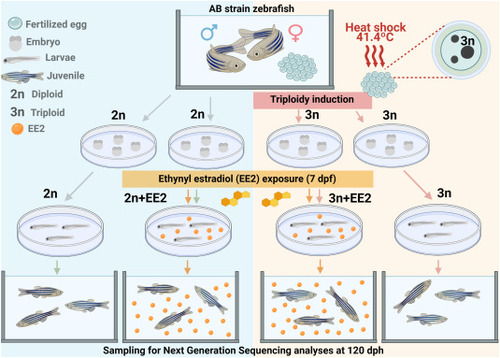
Experimental design: ploidy and 17α-ethinylestradiol (EE2) exposure-based treatments in AB zebrafish. Eggs from five females and sperm from ten males were pooled and used for in vitro fertilization. Fertilized eggs were then divided into diploid (2n) and triploid groups (3n), with triploids induced via heat shock. Fish were exposed to EE2 in water starting at 7 days post-fertilization (dpf) for four months. The experiment included four experimental groups, two controls: diploid control (2n control) and triploid control (3n control), and the treatment groups EE2-treated diploid (2n + EE2) and EE2-treated triploid fish (3n + EE2), which were sampled at the end of the exposure period at 120 dpf. Created in BioRender. MARTINEZ, A. (2025) https://BioRender.com/96w8fup. |
Reprinted from Molecular and Cellular Endocrinology, , Torres-Martínez, A., Tichopád, T., Pšenička, M., Franěk, R., Triploidy alters hormonal and paracrine signaling to promote male development in zebrafish, 112740112740, Copyright (2026) with permission from Elsevier. Full text @ Mol. Cell. Endocrinol.