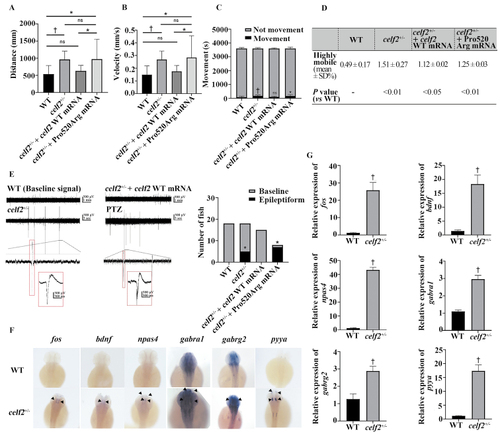
Behavioral locomotion and EEG alterations in celf2+/− zebrafish larvae. (A) The quantification of the total distance traveled for each group. (B) The quantification of the average velocity for each group. (C) The quantification of time spent in movement or not movement of the zebrafish larvae. (D) The activity mobility of the zebrafish larvae. Statistical significance was denoted as follows: (n = 11 in celf2+/− + Pro520Arg mRNA group, n = 14 in other groups, *P <0.05, †P <0.01). (E) Through EEG recording, the celf2+/− group exhibited more epileptic discharges (*P <0.05). (F) In situ hybridization and its quantitative analysis (G) revealed that celf2+/− increased expression of detected marker genes in the brain of zebrafish embryos at 48 h post-fertilization (†P <0.01). Arrowheads indicate the expression sites. Orientation: Dorsal views with head to the top. bdnf: Brain-derived neurotrophic factor; celf2: CUGBP Elav-like family member 2; EEG: Electroencephalogram; fos: Finkel-Biskis-Jinkins murine osteosarcoma viral oncogene homolog; gabra1: γ-aminobutyric acid receptor subunit α1; gabrg2: γ-aminobutyric acid A receptor γ2 subunit; npas4: Neuronal period circadian protein-aryl hydrocarbon receptor nuclear translocator-single-minded protein domain protein 4; PTZ: Pentylenetetrazole; pyya: Peptide YYa; SD: Standard deviation; WT: Wild type.
|
