
Fig. 2
- ID
- ZDB-FIG-260107-4
- Publication
- Koosha et al., 2025 - fam20b-dependent proteoglycans do not affect dermal bone formation and fin regeneration, but Bmp signalling promotes fin regenerate outgrowth
- Other Figures
- All Figure Page
- Back to All Figure Page
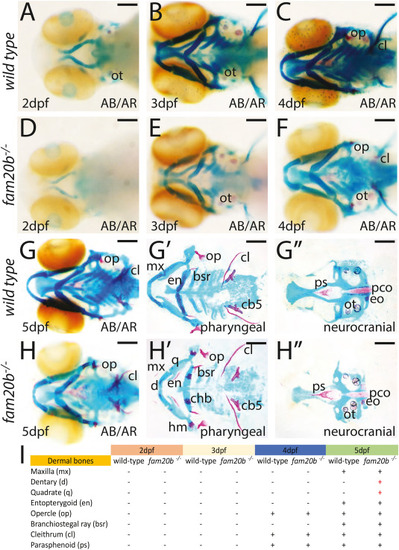
Dermal bone mineralization was not generally accelerated in fam20b−/− embryos. Ventral views of wild-type (A-C,G-G″) and fam20b−/− (D-F,H-H″) zebrafish embryos stained with Alcian blue and Alizarin red. At 2dpf and 3dpf, no mineralization was observed in dermal bones of either wild-type (A,B) or fam20b−/− (D,E) embryos. By 4dpf, Alizarin red staining was observed in the parasphenoid, opercle, and cleithrum of both wild-type (C) and fam20b−/− (F) embryos. By 5dpf, mineralization was also evident in the maxilla, entopterygoid, and branchiostegal ray in both wild-type (G-G″) and fam20b−/− (H-H″) embryos. In addition to several chondral bones, such as the hyomandibular and ceratohyal bone, the dentary and quadrate of fam20b−/− embryos at 5dpf also exhibited Alizarin red staining, which were not observed in wild-type embryos at 5dpf. (I) Summary of dermal bones stained with Alizarin red from 2dpf to 5dpf among wild types and fam20b mutants. n = 10 for each genetic group at each timepoint. Scale bars: A-H’’ = 200 μm. Abbreviations: AB/AR=Alcian blue/Alizarin red; bsr = branchiostegal ray; cb5 = ceratobranchial 5; chb = ceratohyal bone; cl = cleithrum; d = dentary; en = entopterygoid; eo = exoccipital; hm = hyomandibular; mx = maxilla; op = opercle; ot = otolith; pco = perichordal ossification; ps = parasphenoid; q = quadrate. (For interpretation of the references to colour in this figure legend, the reader is referred to the Web version of this article.) |