|
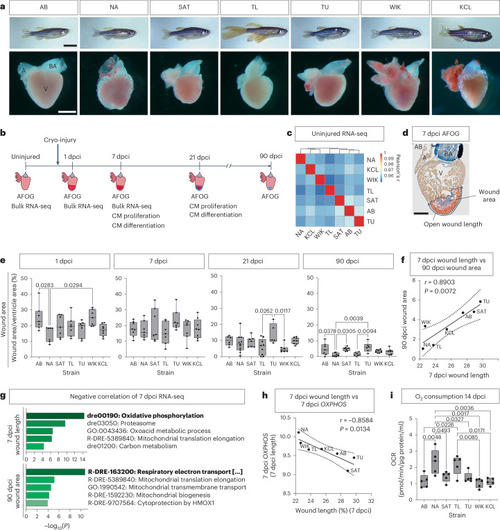
Differential regenerative response to cryo-injury among wild-type adult zebrafish strains identifies OXPHOS as beneficial for regeneration. a, Representative images of adult wild-type zebrafish strains (scale bar, 1 cm) and their intact heart, including atrium (A), bulbus arteriosus (BA) and ventricle (V) (scale bar, 500 μm). b, Experimental procedure to harvest and assay zebrafish hearts prior to and after cryo-injury. c, Correlation matrix of bulk RNA-seq data on uninjured ventricles showing a strong correlation between strains. d, Representative AFOG image of an AB heart at 7 dpci indicating wound area and open wound length measurements (scale bar, 300 µm). e, Wound area quantification of the seven wild-type strains showed significant differences at 1, 21 and 90 dpci among the strains. f, Positive correlation between 7 dpci wound length and 90 dpci wound area. g, The top five enriched processes in the genes negatively correlating to wound length at 7 dpci and area at 90 dpci in the 7 dpci bulk RNA-seq. h, Significant negative correlation between 7 dpci wound length and OXPHOS. i, OCR measurements of 14 dpci ventricles show significant differences in OXPHOS among the seven wild-type zebrafish strains. c, n = 3 biological replicates per zebrafish strain; e, 1 dpci: AB, NA, SAT, TL, TU, WIK n = 7; KCL n = 8. 7 dpci: NA, SAT, TL, TU, WIK n = 7; AB, KCL n = 8. 21 dpci: SAT, WIK n = 7; AB n = 6; NA n = 11; TL n = 9; TU n = 5; KCL n = 8. 90 dpci: AB, NA, SAT, TL, WIK n = 7; TU n = 6; KCL n = 8 (biological replicates). i, n = 5 biological replicates per strain. e,i, One-way ANOVA with Tukey’s test. f–h, Simple linear regression. g, Analysis performed using Metascape. CM, cardiomyocyte. Source data
|