
Fig. 5
- ID
- ZDB-FIG-250910-14
- Publication
- Maloney et al., 2025 - A survey of hypothalamic phenotypes identifies molecular and behavioral consequences of MYT1L haploinsufficiency in male and female mice
- Other Figures
- All Figure Page
- Back to All Figure Page
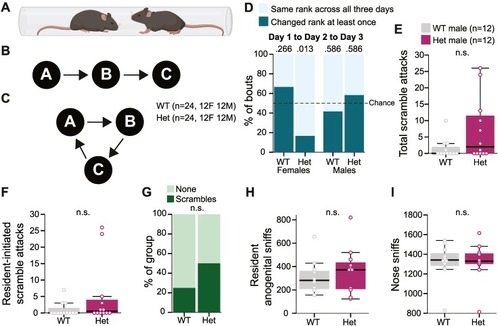
Myt1l mutation had a subtle, sex-specific effect on social rank change but did not influence male-specific aggression. (A) Schematic of the social dominance tube test assay. (B–C) Example of transitive (B) and non-transitive (C) dominance rankings within cages. (D) Only female Het mice showed significantly more instances of maintaining the same dominance rank across days compared to chance. WT females, WT males and Het males demonstrated chance levels for changing rank across days. Left panel: sample size for social dominance assessment. (E) In the resident intruder assay, Het and WT males did not differ significantly in the number of total scramble attacks that occurred. (F) Het and WT males initiated a significant number of scramble attacks. (G) Myt1l mutation was not associated with the occurrence of scramble attacks. (H–I) WT and Het males exhibited a similar number of anogenital sniffs (H) and nose-to-nose sniffs (I). Sample size of males for resident intruder paradigm is presented in panel E. Data in E, F, H & I are presented as boxplots respective group medians as, boxes 25th–75th percentiles, and whiskers 1.5 × IQR. Individual data points are presented as open circles. Data in D & G are presented as counts. One-sample t-test (D), Mann-Whitney U test (E–F, H–I) and Chi-square test (G) used for statistical comparisons. |