
Fig. 8
- ID
- ZDB-FIG-250526-54
- Publication
- Kim et al., 2025 - Cohesin organizes 3D DNA contacts surrounding active enhancers in C. elegans
- Other Figures
- All Figure Page
- Back to All Figure Page
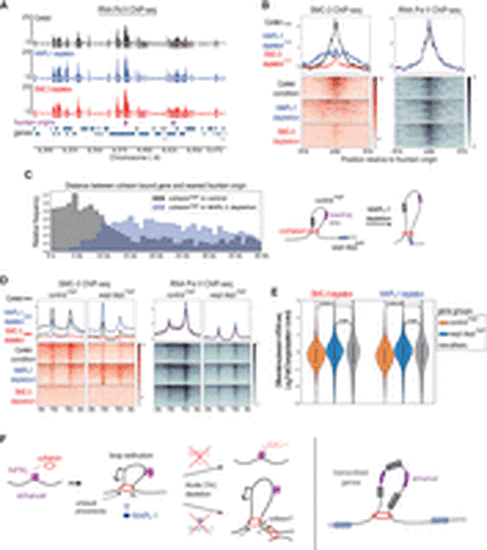
One-hour depletion of SMC-3 or WAPL-1 does not lead to drastic changes in RNA Pol II binding. (A) Genome browser view around fountain origins. Plotted are the input-subtracted ChIP-seq tracks for Pol II in three conditions: control (black), WAPL-1 depletion (blue), and SMC-3 depletion (red). The ticks below the signal tracks indicate MACS2-called peaks. Fountain origins are shown in purple. (B) Average profile and heatmap of SMC-3 and Pol II binding with respect to fountain origins. Plotted are the input-subtracted ChIP-seq tracks SMC-3 and Pol II in three conditions: control (black), WAPL-1 depletion (blue), and SMC-3 depletion (red). (C) Gene annotations from ce10 refGenes are categorized into cohesin high in control condition (gray) or in WAPL-1-depletion condition (blue), and their relative positions are plotted as a histogram from the nearest fountain origin. The two groups are mutually exclusive. The cartoon highlights that genes with higher cohesin binding in control are closer to fountain origins than genes with higher cohesin binding in WAPL-1-depletion condition. (D) Average profile and heatmap of SMC-3 and Pol II binding with over two groups of genes shown in C. Plotted are the input-subtracted ChIP-seq tracks SMC-3 and Pol II in three conditions: control (black), WAPL-1 depletion (blue), and SMC-3 depletion (red). (E) Differential mRNA-seq expression values (log2fc from DESeq2) are plotted for control high (n = 817), WAPL-1 high (n = 1268) genes that were further subsetted to be within 40 kb from the fountain origin, where the differential cohesin binding is the most pronounced. Other genes (n = 15,800) were used as control. Mann–Whitney U-test was used to generate P-values. (F) The proposed model of cohesin loading and loop-extrusion events inferred from the perturbation experiments and literature. Activated enhancers are bound by the NIPBL homolog PQN-85, which increases the frequency of cohesin loading at these sites. After loading, cohesin extrudes DNA in an effectively two-sided manner. Note that despite being depicted as a singular ring, the data cannot distinguish how many cohesin complexes are at the base of the loop. Upon acute depletion of SMC-3, the binding of PQN-85 is unaffected, and a residual amount of SMC-1 is found at loading site. The extruded loop is abolished. Upon acute depletion of the negative regulator WAPL-1, cohesin further extrudes DNA in two-sided manner away from the jet origin. The extended extrusion revealed that a clash between incoming and outgoing cohesin molecules may stall extrusion. Together, cohesin processivity at each side can be unequal and may be facilitated by transcription moving in the same direction. Despite the lack of immediate effect on transcription upon acute SMC-3 and WAPL-1 depletion, the extruded DNA loops encompass multiple cis-regulatory elements and active genes. |