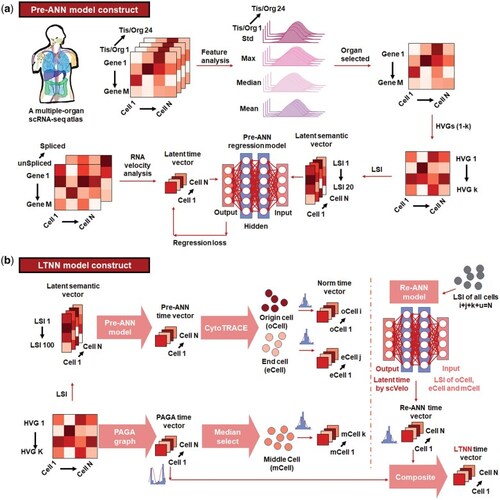
Overview of the scLTNN model. (a) Pre-ANN model construct. The construction of the Pre-ANN model begins with the original scRNA-seq data of 24 human tissues and organs, obtained from a recent publication (Tabula Sapiens Consortium et al. 2022). Each tissue/organ contains N cells and M genes. Initially, the distribution features of gene expression in each organ are analyzed, and genes with similar expression features are filtered out. The remaining HVGs (1−k) of cells (1−N) in each tissue/organ are then assigned values of the LSI, resulting in latent semantic vectors. These latent semantic vectors with LSI values are set as the input for Pre-ANN regression. Concurrently, the latent time vectors, generated by VeloVI based on the unspliced and spliced mRNA matrix of the same organ, are set as the output for regression. Ultimately, the Pre-ANN model is trained through loss evaluation. (b) LTNN model construct. Initially, the origin and end cell clusters are determined using the pre-ANN time vector, which is regressed by the pre-ANN model and further refined by CytoTRACE according to gene expression. Subsequently, the middle cell cluster is determined by the PAGA time vector, constructed using the HVG matrix and origin cells. The Re-ANN model is then constructed, using the LSI of origin, middle, and end cells as input, and the latent time of these cells, calculated by VeloVI, as output. Finally, the LTNN model is obtained by integrating the statistical distributions of Re-ANN time and PAGA time. Tis/Org, tissues and organs; Std, standard deviation; Max, maximum value; Median, median value; Mean, mean value; HVGs, high-variable genes; LSI, Latent Semantic Index; Pre-ANN, the pre-trained artificial neural network model; Re-ANN, the repeated-ANN model.
|
