
Fig. 2
- ID
- ZDB-FIG-250220-13
- Publication
- Kim et al., 2024 - CRISPR-Cas13d as a molecular tool to achieve targeted gene expression knockdown in chick embryos
- Other Figures
- All Figure Page
- Back to All Figure Page
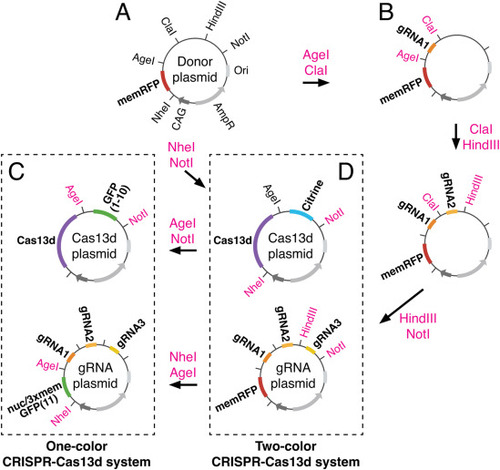
Sequential cloning strategy used to generate one- and two-color CRISPR-Cas13d systems. (A) Donor plasmid supplying the backbone vector contains the following features: Origin of replication (Ori), Ampicillin resistance (AmpR), ubiquitous promoter (CAG), and a membrane-localized RFP reporter (memRFP), as well as a multiple cloning site. Relevant restriction sites are shown. (B-D) Donor plasmid was digested with indicated restriction enzymes and ligated iteratively to insert three guide RNAs (gRNAs). Three variations of the gRNA plasmid were created: one containing memRFP for a two-color system (D), and two others containing split GFP(11) reporters that are either nuclear (nucGFP(11)) or membrane localized (3xmemGFP(11)) for a one-color system (C). Donor plasmid was also separately digested with indicated restriction enzymes and ligated with respective inserts to create two variations of the Cas13d plasmid: one containing a split GFP reporter (GFP(1–10)) for the one-color system (C), and the other containing a Citrine reporter for the two-color system (D). (For interpretation of the references to color in this figure legend, the reader is referred to the Web version of this article.) |
Reprinted from Developmental Biology, , Kim, M., Hutchins, E.J., CRISPR-Cas13d as a molecular tool to achieve targeted gene expression knockdown in chick embryos, , Copyright (2024) with permission from Elsevier. Full text @ Dev. Biol.