
Fig. 2
- ID
- ZDB-FIG-221107-2
- Publication
- Choo et al., 2021 - Identification of curcumin analogues with anti-seizure potential in vivo using chemical and genetic zebrafish larva seizure models
- Other Figures
- All Figure Page
- Back to All Figure Page
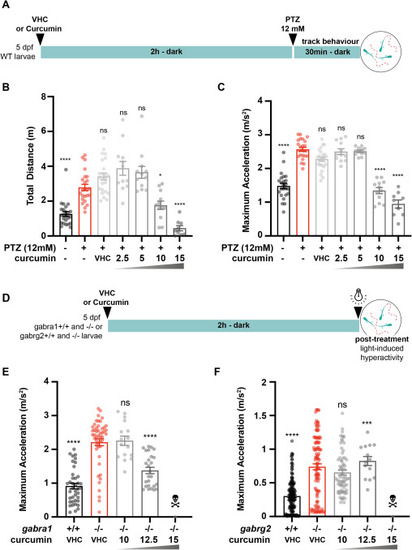
Fig. 2. Anti-seizure property of curcumin in vivo (A) Timeline of the experimental procedure corresponding to our PTZ behavioural hyperactivity assay. (B & C) Quantification of the total distance travelled (m) and maximum acceleration (m/s2) of 5 dpf zebrafish larvae treated or not with PTZ 12 mM and pre-incubated or not with curcumin at different concentrations (0 – 15 µM) The * ** * marker denotes significance at P < 0.0001 respectively as compared to the 12 mM PTZ only group using one-way Analysis of Variance (ANOVA) followed by Dunnett's post hoc test. (D) Timeline of the experimental procedure corresponding to our behavioural hyperactivity assay using gabra1-/- and gabrg2-/- genetic seizure models. (E, F) Quantification of the maximum acceleration (m/s2) of gabra1 + /+ and -/- (E) or gabrg2 + /+ and -/- (F) larvae. Larvae were incubated with different concentration of curcumin (10 – 15 µM). The * ** * marker denotes significance at P < 0.0001 respectively as compared to the homozygous (-/-) group using one-way Analysis of Variance (ANOVA) followed by Dunnett's post hoc test. VHC (vehicle) treatments correspond to 0.1% DMSO. |
| Fish: | |
|---|---|
| Conditions: | |
| Observed In: | |
| Stage: | Day 5 |