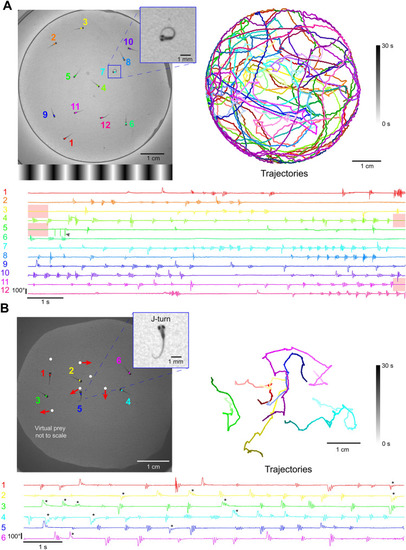
Multi-animal tracking during OMR and prey capture. (A) The position and tail curvature of 12 larvae tracked (332 Hz) during the presentation of an OMR stimulus. The direction of the OMR stimulus changed to traverse leftward or rightward depending on whether the center of mass of the group crossed into the rightmost quarter or leftmost quarter of the arena, respectively. Trajectories are individually color coded by fish and shaded by time. The tail curvature for each fish is represented as the average of the 3 most caudal tail segments. Post processing of the tail curvature data revealed sections of the data when fish physically contacted each other (red highlighted regions). The tail tracking results surrounding these encounters decreased in accuracy and occasionally produced tracking errors (arrow). (B) Freely swimming larvae in a group of 6 were tracked and presented with multi-prey stimuli projected from below. Virtual prey were programmed to produce paramecia-like behavior, defined as periods of forward movement, brief pauses, and changes in orientation. The linear velocity, distance, length of pause, angular velocity, and orientation were varied for each virtual prey. Larvae produced distinct J-turns in response to virtual prey (* = manually identified J-turn).
|
