
- Title
-
Comparative in situ hybridization protocols in zebrafish
- Authors
- Dunn, K., Vashisht, A., Hammond-Weinberger, D.R.
- Source
- Full text @ Biotechniques

Figure 1. Bleaching reduces superficial signal detection. (A & B) First natural pigmentation is visible in the developing retina (arrowhead) at 24 h postfertilization. Untreated embryos have the clearest, most detailed atoh1b staining in the hindbrain (arrow). (C & D) Postfixation bleaching in H202 eliminates pigmentation in the retina (arrowhead) but reduces expression detail in the hindbrain (arrow). (E & F) Treatment with 0.2 mM PTU prevents pigmentation in the retina (arrowhead) with minimal reductions in staining clarity in the hindbrain (arrow). Scale bar = 100 μm. |
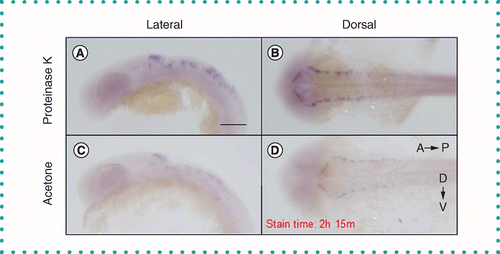
Figure 2. Comparing permeabilizing agents. Expression at 24 h postfertilization with (A & B) standard 10 μg/ml proteinase K treatment versus (C & D) 80% acetone permeabilization. Embryos treated with proteinase K stained more rapidly. Embryos were deyolked for clarity. Embryos were naturally pigmented. Scale bar = 100 μm. |
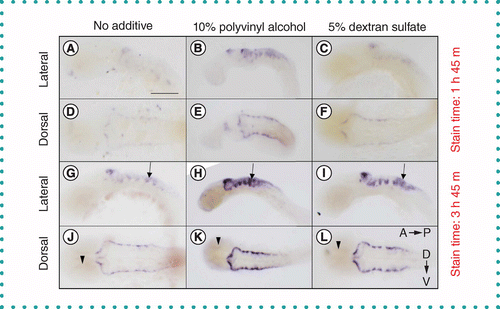
Figure 3. Additives improve signal detection. Nitro-blue tetrazolium chloride paired with 5-bromo-4-chloro-3-indolyl phosphate (NBT/BCIP) staining of atoh1b compared with and without volume excluding additives in 24 h postfertilization zebrafish embryos. (A–F) Embryos from the same batch were stained until first color appearance in controls (A & D). (G–L) Embryos stained to completion. (B, E, H & K) Polyvinyl alcohol (10%) enhances signal intensity of real and background stain (eye region; arrowheads). (C, F, I & L) Dextran sulfate (5%) increases sensitivity (hindbrain; arrow) without increasing background. Embryos were manually deyolked. Scale bar = 100 μm. |
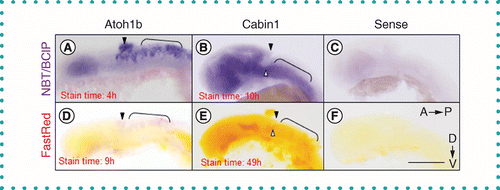
Figure 4. Single in situ hybridization for atoh1b demonstrates the superiority of NBT/BCIP as a stain. (A–C) NBT/BCIP is more sensitive and offers higher contrast. (D–F) Fast Red displays less nonspecific staining in red, although discolors the otherwise clear embryo yellow. (A & D)Atoh1b is expressed in the rhombic lip (filled arrowhead) and hindbrain (bracket) in zebrafish embryos at 24 h postfertilization. Both stains label the predicted region and display paler, nonspecific staining, particularly in the eye. (B & E)Cabin1 is expressed in many brain regions, including the ventral rhombic lip (open arrowheads) and hindbrain (bracket). (C & F) Sense probes for Cabin1 served as controls. Embryos were manually deyolked. Scale bar = 100 μm. |

Figure 5. Stain pairings in double in situ hybridization vary widely in efficacy. Lateral and dorsal views of each gene pair with sense probes for comparison following antisense probes. (A)Cabin1 detected with NBT/BCIP (indigo) obscures atoh1b detected with Fast Red (red). (B–E)Atoh1b detected with NBT/BCIP (indigo). (B–D) Fast Red (red), DAB (brown), and Vector Red (yellow) are not sensitive enough to detect Cabin1. (E) Fast Red/BCIP labels Cabin1 without masking atoh1b. Sense probes do not reveal specific staining. Embryos were manually deyolked. Scale bars = 100 μm. |