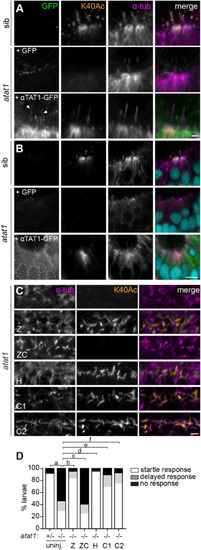
⍺TAT1 enzymatic activity is required for touch-evoked behavior and is conserved across species (A–B) Immunofluorescence of medial cristae hair cells in wild-type siblings, atat1 mutants injected with GFP mRNA, and atat1 mutants injected with ⍺TAT1-GFP mRNA, stained for GFP, α-tubK40Ac, and α-tub. Arrows indicate presence of GFP at cilia. Outlines of nuclei indicated by white segmented lines. Scale bar, 2 μm (A) and 5 μm (B). (C) Immunofluorescence of central canal cilia in 1 dpf larvae showing restoration of α-tubK40Ac following mRNA injection of ⍺TAT orthologs. Scale bar, 5 μm. (D) Quantification of touch responsiveness in uninjected sibling controls (uninj.; n = 22), uninjected atat1 mutants (n = 31), and atat1 mutants injected with zebrafish ⍺TAT1 (Z; n = 18), catalytically inactive zebrafish ⍺TAT1 (ZC; n = 20), human ⍺TAT1 (h; n = 19), C. elegans Mec17 (C1; n = 26), or C. elegans Atat2 (C2; n = 24). Statistical comparisons were performed using chi-square tests, with P values as follows: a = 7.9 × 10⁻⁴, b = 6.8 × 10⁻⁴, c = 0.93, d = 3.5 × 10⁻⁵, e = 2.0 × 10⁻³, f = 7.9 × 10⁻⁴.
|
