
Fig. 6
- ID
- ZDB-FIG-260530-138
- Publication
- Tsai et al., 2026 - Zebrafish gon4la mutants recapitulate human GON4L-related growth disorders and reveal novel metabolic organs abnormalities
- Other Figures
- All Figure Page
- Back to All Figure Page
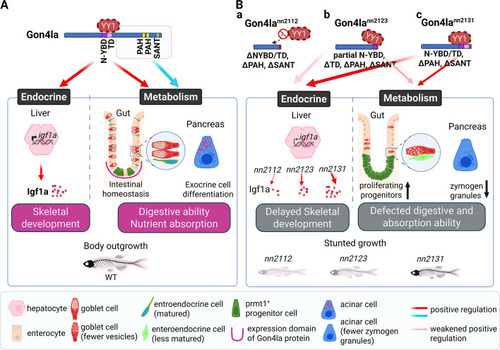
Proposed model illustrating domain specific functions of Gon4la in post-embryonic growth regulation. (A) WT scenario: Full-length WT Gon4la utilizes its N-terminal YY1-binding domain (N-YBD) and putative transactivation domain (TD) (solid red arrow) to regulate endocrine signaling (e.g., hepatic Igf1a production for skeletal development). Its C-terminal PAH and SANT domains (solid blue arrow) are crucial for metabolic organ homeostasis (e.g., intestinal integrity, pancreatic exocrine cell differentiation), collectively supporting normal post-embryonic growth. (B) gon4la mutant scenarios: (a) gon4lann2112 (complete loss of N-YBD, TD, PAH, and SANT domains): this severe truncation prevents YY1 interaction and leads to impaired hepatic igf1a production, delayed skeletal development, and increased mortality; (b) gon4lann2123 (retention of partial N-YBD but loss of TD, PAH, and SANT domains): this mutant shows an intermediate reduction in igf1a levels and skeletal abnormalities, potentially due to the retaining N-YBD capacity; (c) gon4lann2131 (retention of N-YBD and TD but loss of PAH and SANT domains): this mutant exhibits the least severe endocrine disruption, with igf1a levels comparable to WT. Notably, the bone mineral density (BMD) is decreased in gon4lann2112 (light gray skeleton) and gon4lann2123 (gray skeleton), while BMD of gon4lann2131 (black skeleton) remains comparable to WT. All three mutants lacking PAH/SANT domains, display significant intestinal and pancreatic abnormalities, including increased progenitor proliferation and defective differentiation. This underscores the role of these C-terminal domains in metabolic organ function. Because a mutant specifically lacking only the N-YBD or TD (while retaining PAH/SANT) was not generated, potential contributions of Gon4la’s N-YBD or TD to metabolic organ homeostasis (dotted black arrows) cannot be completely ruled out. Cellular phenotypes depicted: Goblet cells (matured vs. fewer vesicles), enteroendocrine cells (matured vs. less matured), prmt1+ progenitor cells, enterocytes, and acinar cells (normal vs. fewer zymogen granules). Expression domain of Gon4la protein in intestinal folds is indicated by the U-shaped magenta line. Arrow/Line key: Solid red arrow = positive regulation by N-YBD/TD on the endocrine system or metabolic organs; faint red arrow = weakened positive regulation; solid blue arrow = positive regulation by PAH/SANT domains on metabolism. This figure is created with BioRender.com. |