
Fig. 6
- ID
- ZDB-FIG-260528-27
- Publication
- Martinez-Mayer et al., 2026 - Generation of a prop1 knockin zebrafish enables single-cell transcriptomics of early pituitary development
- Other Figures
- All Figure Page
- Back to All Figure Page
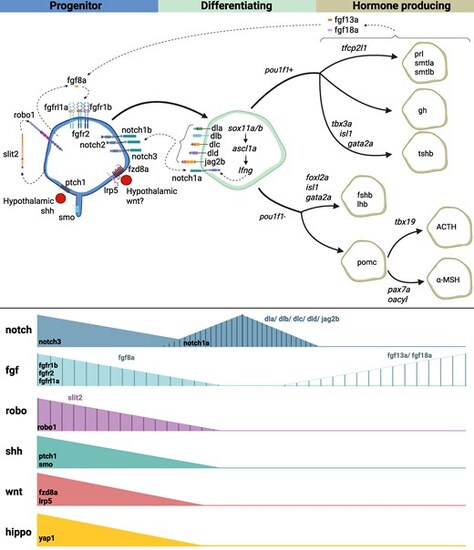
Steps and pathways regulating early pituitary development in zebrafish. The schematic illustrates representative cell states along pituitary development, including early progenitors, differentiating cells, and terminally differentiated hormone-producing cells. For each stage, key transcription factors defining cell identity are indicated, including tfcp2l1, tbx3a, isl1, gata2a, foxl2a, tbx19, pax7a, and pou1f1 –positive and –negative lineages. Hormone-producing populations expressing prl, gh, tshb, fshb, lhb, and pomc (ACTH/α-MSH) are shown (upper panel). Major signaling pathways implicated in pituitary differentiation are depicted, including FGF, Notch, SHH, Wnt, Robo/Slit, and Hippo signaling. Relevant ligands and receptors expressed at each stage are indicated, such as fgf8a, fgf13a, and fgf18a, and their receptors (fgfr1b, fgfr2, and fgfrl1a); Notch ligands (dla, dlb, dlc, dld, and jag2b) and receptors (notch1a, notch1b, notch2, and notch3); SHH pathway components (shh, ptch1, and smo); Wnt pathway components (fzd8a and lrp5); and Robo/Slit signaling (slit2 and robo1). The presumed activity of the Hippo pathway (yap1) is also indicated. Expression of ligands is shown in vertical stripes while expression of receptors or downstream targets is shown in solid color (lower panel). The model integrates differential gene expression patterns and inferred pathway activity to highlight stage-specific regulatory mechanisms governing pituitary lineage commitment and hormonal differentiation, including potential hypothalamic inputs at early progenitor stages. |