|
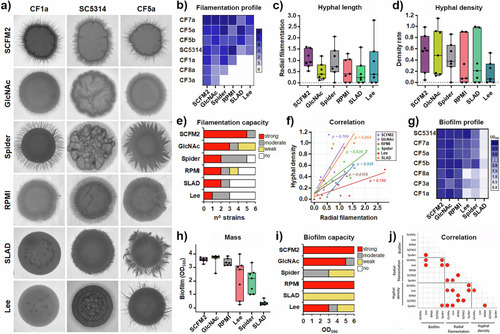
Clinical isolates of Candida albicans retain the capacity to undergo filamentation and biofilm formation across a range of environmental conditions. a Clinical CF isolates were examined for their filamentation ability in different media, including SCFM2. Representative colony images from three independent experiments are shown. The reference strain SC5314 was used as control. b Colour-based heatmap showing the different filamentation profile among CF isolates across tested media, assessed by c radial filamentation and d hyphal density, quantified to capture filamentation-related phenotypes. Each spot indicates an individual CF isolate and represents the mean value of three independent measurements. e Filamentation capacity of clinical CF isolates in different media, categorized by radial filamentation and hyphal density, showing that SCFM2 is the strongest inducer of filamentation. f Correlation analysis between filament length and hyphal density, performed for each medium using Spearman’s rank correlation, revealing the strongest positive association in SCFM2. Linear trend lines are shown for visualization only. g Colour-coded heatmap demonstrating the ability of all clinical CF isolates to form biofilms under various environmental cues h determined by measuring biofilm mass (CV assay) (n = 6). i Biofilm-forming capacity of CF isolates across different media categorized by the following criteria: OD590 > 3 (strong), 1 < OD590 ≤ 3 (moderate), 0.2 < OD590 ≤ 1 (low), OD590 ≤ 0.2 (non-biofilm forming). j Correlation analysis between biofilm-related characteristics – biofilm mass, radial filamentation and hyphal density, represented by Pearson’s correlation. Red spot indicates statistically significant correlation p < 0.05.
|