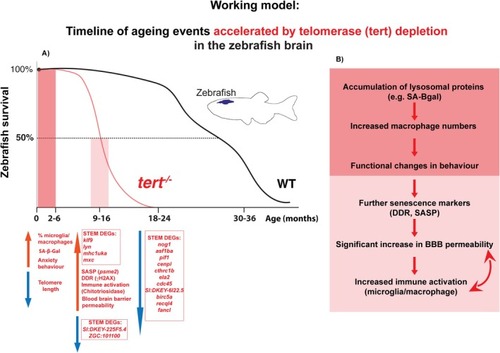
Working model: Timeline of ageing events accelerated by telomerase depletion in the zebrafish brain. (A) Survival curve showing the early to late stages of ageing in WT fish compared to tert−/− fish, highlighting the changes we identify at cellular, tissue, and functional levels with ageing and that are accelerated in the absence of telomerase, at different ages throughout their life course. (B) Table summarising the sequence of events we observe in the ageing brain and that are accelerated by telomerase depletion: Accumulation of lysosomal proteins (such as SA‐β‐Gal), increased number of macrophages, and increased anxiety‐like behaviour are already observed at the young age of 2–6 in tert−/− fish (but only at later ages in WT fish). Dysfunction at lysosomes and recruitment of immune cells are likely to contribute to a senescence phenotype by increasing senescence‐associated markers such as SASP and DDR, which are observed at 9–16 months in tert−/−. This is accompanied by increased immune activation (increased chitotriosidase activity) and BBB permeability at the same age, potentially as a consequence of increased inflammation and accumulation of cellular senescence. In turn, BBB leakiness is likely to lead to further recruitment of immune cells from the periphery, further exacerbating inflammation and BBB dysfunction in a positive feedback loop.
|
