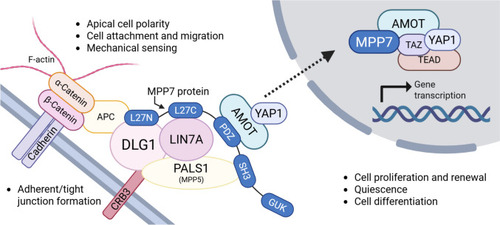
A schematic representation of presumed model of protein interactions of MPP7. MPP family proteins are adaptor molecules that assemble protein complexes consisting of protein families such as Crb homologues (e.g., CRB1, CRB3), DLT homologues, and LIN7 homologues (e.g., LIN7A, LIN7B, or LIN7C), together forming a cell adhesion signaling apparatus involved in establishment and maintenance of apical polarity at sites of adherent or tight junctions. MPP7 protein consists of several domains (i.e., L27N, L27C, PDZ, SH3, and GUK domains) that serve as docking sites for other proteins. While the DLG1–LIN7A–MPP7 protein complex is mainly involved in stabilization of the protein junctions, it also serves as a docking site for AMOT and YAP1 proteins, forming the MPP7–AMOT–YAP1 complex. Based on cell activity and signals form the extracellular environment, this complex can detach and serve as a shuttling complex for YAP1 nuclear entry, where it is also involved in formation of the YAP1/TAZ–TEAD transcriptional regulator complex, which regulates cell growth, proliferation, stem cell renewal, and differentiation. MPP7 protein is thus involved in establishment and stabilization of cell apical polarity through adherent and tight junctions, as well as in processes of cell proliferation, quiescence, and cell differentiation. DLG1 disks large homolog 1, LIN7 Lin-7 homolog, AMOT angiomotin, YAP1 yes-associated protein 1, TAZ (also WWTR1)—Tafazzin family protein, TEAD TEA domain transcription factor 1, APC adenomatous polyposis coli, CRB3 crumbs cell polarity homolog-3, PALS1 (also MPP5) protein associated with LIN7 1
|
