|
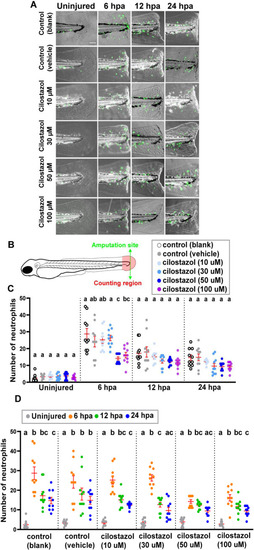
The effect of cilostazol treatment on the accumulation of Mpx-expressing neutrophils during fin amputation and regeneration. (A) The embryos of Tg(mpx:EGFP) line were subject to treatments of cilostazol at 10, 30 50 and 100 μM respectively, or blank and vehicle controls, from 24 hpf onwards. 10 embryos were contained in each treatment group for the time course analysis. The amputation of caudal fin fold was performed on the zebrafish embryos at 3 dpf, and live imaging was used to visualize and record the GFP-expressing neutrophils in the tail region of embryos prior to amputation as well as 6, 12 and 24 hpa respectively. (B) The green dotted line in the schematic diagram indicates the site of resection, and the area in-between levels of the anterior edge of pigment gap and the posterior edge of regenerating fin was selected for neutrophil quantification. (C) A comparison of neutrophil accumulation in the selected counting region, among different treatment groups at the uninjured fins; or at regenerating fins at 6, 12 and 24 hpa respectively. For each time point, differences in the number of neutrophils were compared among various treatment groups. Kruskal-Wallis followed by Dunn’s test was performed for the analysis of uninjured and 6 hpa groups. Welch’s ANOVA followed by Games-Howell test was performed for the analysis of 12 and 24 hpa groups. Columns of data with different letters above them are significantly different (P < 0.05). (D) A comparison of neutrophil accumulation in the wounded fin area among different time points after fin amputation, in each treatment group. Kruskal-Wallis followed by Dunn’s test was performed for the analysis of blank and vehicle control groups, as well as for the 10, 30 and 50 μM cilostazol treated groups. Welch’s ANOVA followed by Games-Howell test was performed for the 100 μM cilostazol treated group. Columns of data with different letters above them are significantly different (P < 0.05).
|