|
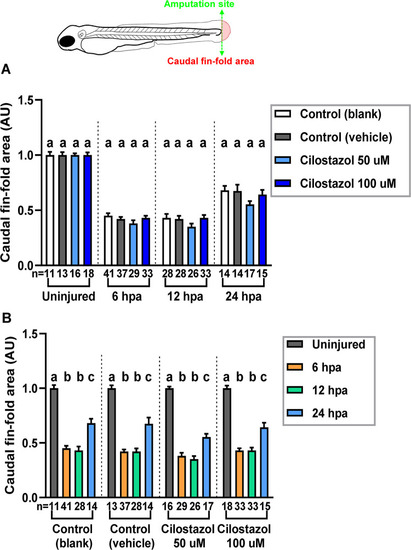
The effect of cilostazol on the regeneration of caudal fin fold zebrafish. The embryos subject to the cilostazol treatments and fin amputation as in S2 Fig. were analyzed to evaluate whether cilostazol affects the regeneration of fin fold post-injury. The regenerated fin area is defined as the surface area of the fin fold posterior to the amputation site, as viewed laterally. (A) The regenerated caudal fin area of the injured embryos under different treatments are quantified and compared at 6, 12 and 24 hpa respectively, following the amputation at 3 dpf. The uninjured fin areas posterior to the hypothetical site of resection are also quantified and compared among different treatments at 3 dpf. ANOVA analysis followed by Scheffé test was performed for comparisons among different treatment groups of uninjured fins, and injured fins at 24 hpa. Kruskal-Wallis followed by Dunn’s test was performed for comparisons among different treatment groups of injured fins at 6 and 12 hpa. Histograms with different letters above them are significantly different (P < 0.05). (B) The regenerated fin area for each type of cilostazol or control treatments is compared among 6, 12 and 24 hpa following amputation at 3 dpf; and contrasted with the caudal fin area of uninjured embryos at 3 dpf. Kruskal-Wallis followed by Dunn’s test was performed for the analysis of blank control group. Welch’s ANOVA followed by Games-howell test was performed for the analysis of vehicle control and 50 μM cilostazol treatment groups. ANOVA analysis followed by Scheffé test was performed for the analysis of 100 μM cilostazol treatment group. Histograms with different letters above them are significantly different (P < 0.05).
|