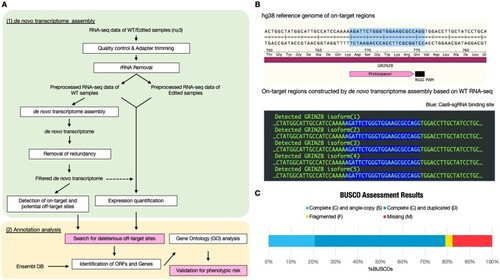
Overview of DANGER analysis and on-target region constructed by de novo transcriptome assembly. (A) Bioinformatic workflow of DANGER analysis. Our analysis requires RNA-seq data derived from WT and edited (each n ≥ 3). DANGER analysis has two steps in the workflow: (i) de novo transcriptome assembly (upper background box) and (ii) annotation analysis (lower background box). The de novo transcriptome assembly step is processed with Trinity and preprocessing tools, such as cutadapt and bbduk.sh. Crisflash performs the search of on/off-target sequences. The RSEM quantifies gene expression in edited RNA-seq samples in comparison to the WT de novo transcriptome (dot allow). The step of annotation analysis was involved processing with TransDedoder, ggsearch, org. XX.eg.db (e.g. org. Hs.eg.db in the transcriptome related to humans), and topGO. We implemented specific modules, colored in pink, for considering the phenotypic effect of deleterious off-targets. (B) Comparison between the hg38 reference genome and transcript sequence constructed by de novo assembly of RNA-seq samples derived from WT iPSC-derived cortical neurons on the GRIN2B on-target region. The on-target region of the hg38 reference genome is illustrated with annotations of the GRIN2B CDS, the protospacer, and the NGG PAM sequence of SpCas9. The detected GRIN2B isoforms (1–5) are lined up in the box. The Cas9–sgRNA binding sites are highlighted. (C) Genome completeness of de novo transcriptome assembly RNA-seq data derived from WT iPSC-derived cortical neurons was assessed using conserved mammal BUSCO genes (mammalia_odb10). The result was 79.1% of “complete,” 20.7% of “single-copy,” 58.4% of “duplicated,” 3.2% of “fragmented,” and 17.7% of “missing” (n = 9226).
|
