
|
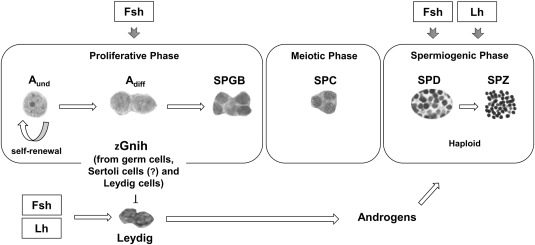
Fig. 8 Fig. 8. A proposed model of the paracrine effects of zGnih and gonadotropins (Lh and Fsh) on zebrafish spermatogenesis. The figure illustrates the progression of spermatogenesis from type A undifferentiated spermatogonia to haploid spermatozoa cells in the presence of locally produced zGnih peptides from germ cells, Sertoli cells, and Leydig cells (Fallah et al., 2019). The diagram also illustrates the involvement of Leydig cells in the production of androgens leading to cellular differentiation, meiosis and spermiogenesis. Lh and Fsh signaling both stimulate spermatogenesis; however, they differentially regulate this process and function on different phases of spermatogenesis. zGnih is capable of inhibiting both Lh and Fsh induced-spermatogenesis by altering the number of spermatogonia cells and their proliferative activity or affecting the androgen production. Blocked lines represent inhibition. Aund: type A undifferentiated spermatogonia, Adiff: type A differentiated spermatogonia, B: type B spermatogonia, SPC: spermatocytes, SPD: spermatids, SPZ: spermatozoa.
Reprinted from Molecular and Cellular Endocrinology, 520, Fallah, H.P., Rodrigues, M.S., Zanardini, M., Nóbrega, R.H., Habibi, H.R., Effects of gonadotropin-inhibitory hormone on early and late stages of spermatogenesis in ex-vivo culture of zebrafish testis, 111087, Copyright (2020) with permission from Elsevier. Full text @ Mol. Cell. Endocrinol.