
|
Fig. 9
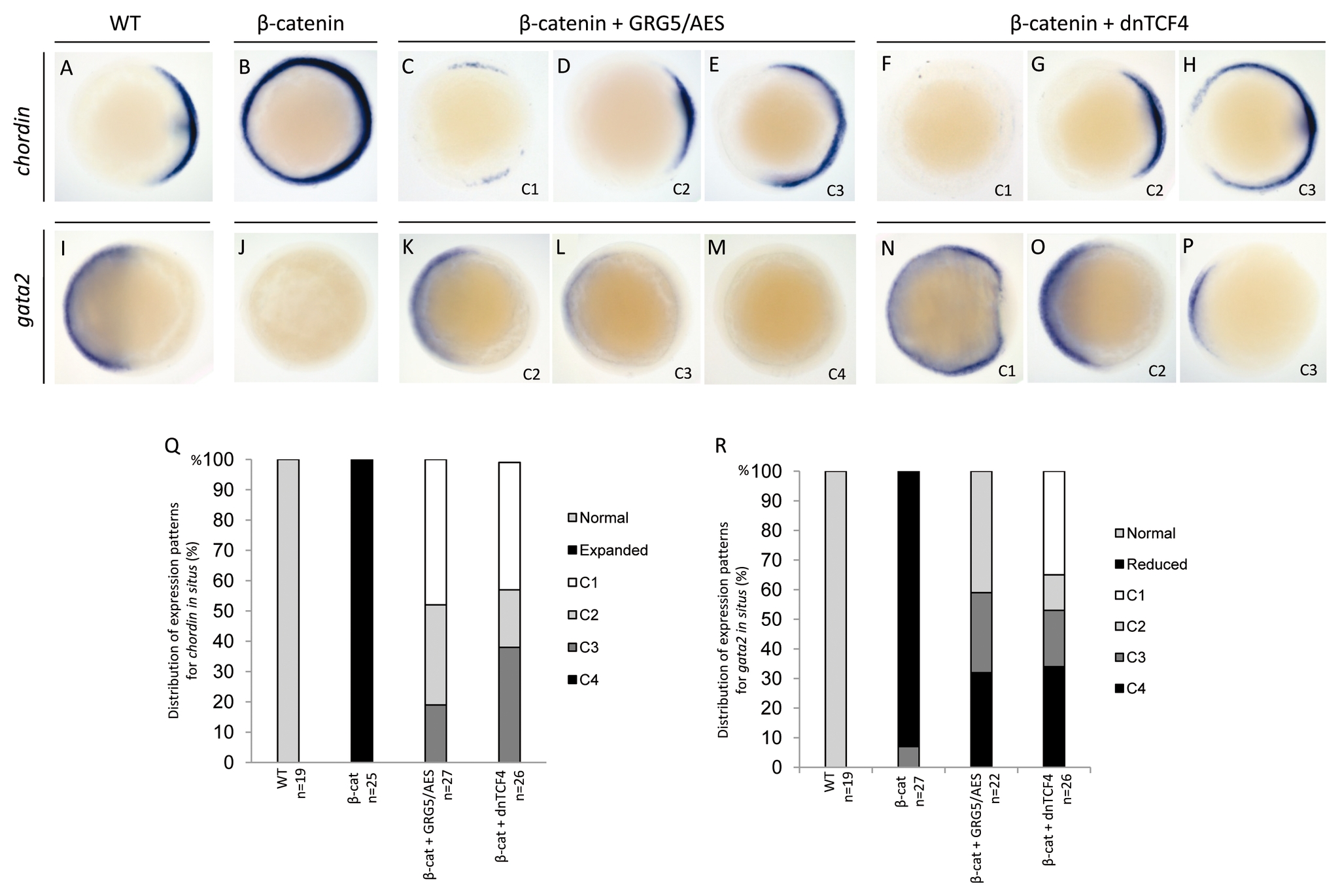
GRG5/AES antagonizes β-catenin in dorsal-ventral patterning during early zebrafish embryogenesis.
Whole-mount in situ hybridizations for chordin (A–H) and gata2 (I–P) of double-injection experiments (columns). Animal pole views, dorsal to the right, of 70% epiboly stage-embryos. Injection of β-catenin strongly dorsalizes embryos, as shown by an expanded and circumferential expression of the dorsal-specific gene chordin (B) and a total absence of the ventral-specific gene gata2 (J). Co-injection of grg5/aes (C-E; K-M) rescues β-catenin-induced dorsalization and restores normal expression domains for both marker genes. dntcf4 co-injections (F–H; N–P) were used as a control for β-catenin antagonism. Co-injected embryos were grouped in four classes of marker gene expression: C1 (C, F) – abnormal expression consistent with embryo ventralization; C2 (D, G; K,O) restoration of normal expression patterns (A,I); C3 (E, H; L, P) – partial reversion of β-catenin-induced abnormalities; C4 (M) abnormal expression consistent with embryo dorsalization. Q–R: distribution of the embryos in the different classes of chordin (Q) and gata2 (R) expression. GRG5/AES antagonizes β-catenin effects on chordin and gata2 in 100% and 68% of the embryos respectively. n: number of embryos tested.