
Fig. 1
- ID
- ZDB-FIG-260526-1
- Publication
- Bastos et al., 2026 - Loss of Cathepsin Z enhances pro-inflammatory macrophage responses and promotes tissue regeneration in zebrafish
- Other Figures
- All Figure Page
- Back to All Figure Page
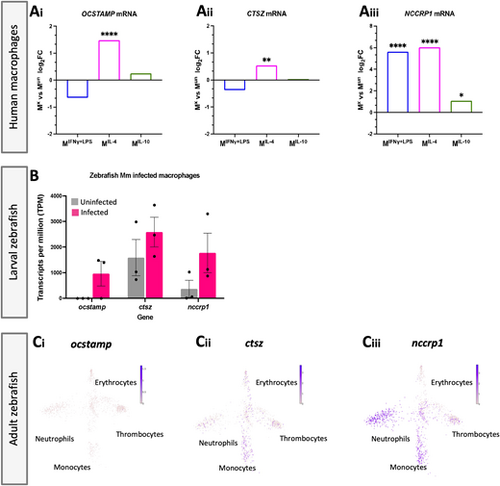
Comparison between RNA-sequencing (RNAseq) datasets obtained from human polarized macrophages and zebrafish Mycobacterium marinum (Mm)-infected macrophages identified three candidate genes for anti-inflammatory macrophages. (Ai-iii) RNAseq of human macrophages polarized in vitro from eight donors (Baidžajevas et al., 2020). M1 macrophages were polarized with IFNγ+LPS (MIFN+LPS); M2-like macrophages were polarized with either IL-4 (MIL-4) or IL-10 (MIL-10). Polarized macrophages were compared to unpolarized ones. Expression of OCSTAMP (Ai), CTSZ (Aii) and NCCRP1 (Aiii) in polarized macrophages compared to unpolarized macrophages is shown. To comply with the ethical approval of the original study, data are presented as mean values only, as individual biological replicate data were not available for publication. FC, fold change. (B) RNAseq of 5 days post-infection isolated zebrafish macrophages following Mm infection (Rougeot et al., 2019). For this analysis, 20 infected and uninfected cells were fluorescence-activated cell sorting (FACS) purified (n=3 independent repeats) and used for cDNA synthesis, with resulting cDNA amplified for RNAseq. Data are means from three replicates; error bars depict s.e.m. No statistical differences were identified using an unpaired two-tailed t-test. (Ci-iii) Expression levels of these genes in four zebrafish blood cell types: erythrocytes, neutrophils, monocytes and thrombocytes. The atlas was generated with single-cell RNAseq (scRNAseq) of FACS-purified kidney-derived blood cells from eight transgenic and one non-transgenic fish, obtained from BASiCz – Blood Atlas of Single Cells in zebrafish. Interestingly, there is very little expression of ocstamp in adult zebrafish leukocyte populations (Ci). Expression of ctsz also shows minimal expression in leukocyte populations, but it is most prominently expressed in monocytes (Cii). This suggests that ocstamp and ctsz could be strong candidates for anti-inflammatory macrophages as low expression levels in unchallenged fish would be expected. However, nccrp1 is more widely expressed, particularly in both neutrophil and monocyte adult leukocyte populations (Ciii), suggesting that this gene may not be specific enough to be an anti-inflammatory macrophage marker. Each arm of the diagram indicates a haematopoietic cell population, and each dot represents separate single-cell RNAseq repeats performed. Populations are labelled on the image. Deeper colour indicates higher gene expression in that population. *False discovery rate (FDR)<0.05; **FDR<0.01; ****FDR<0.0001. |