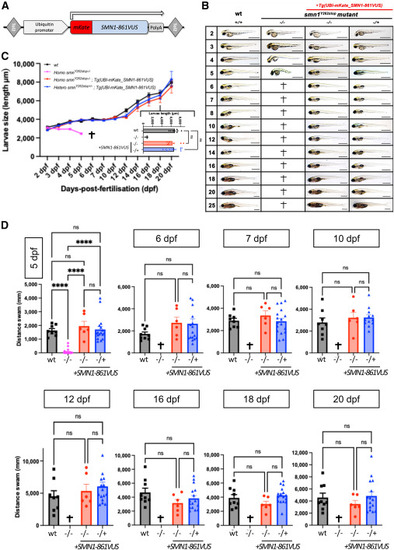
SMN1-861VUS transgene fully complements the loss of SMN function in zebrafish (A) DNA transgene Tg(UBI-mKate_SMN1-861VUS) integrated into the genome of zebrafish mutants smn1Y262stop−/+. (B) Representative images showing morphology from 2 to 25 days post-fertilization (dpf). Homozygous smn1Y262stop−/− mutants exhibit progressive deterioration and premature death between 5 and 6 dpf, while expression of Tg(UBI-mKate2-SMN1-861VUS) restores normal development, morphology, and survival. Scale bar: 1,000 μm. (C) Growth curves showing larval length measurements (±SEM) from 2 to 20 dpf. No significant difference was observed between wild-type (WT), heterozygous, and Tg(UBI-mKate_SMN1-861VUS)-complemented smn1Y262stop−/− animals. The inset (bottom right) highlights comparable body size at 18 dpf. (D) Motor function comparison from 5 to 20 dpf. Total distance swam (±SEM) during a 24-min recording. Homozygous smn1Y262stop−/− mutants display rapid motor function loss culminating in near paralysis by 5 dpf, whereas the transgene Tg(UBI-mKate_SMN1-861VUS) restores normal locomotor activity indistinguishable from WT and heterozygous controls. Data were analyzed using a non-parametric Kruskal-Wallis test, followed by Dunn’s post hoc correction for multiple comparisons; ∗∗∗∗p < 0.0001.
|
