
Fig. 1
- ID
- ZDB-FIG-260414-6
- Publication
- Wirth et al., 2026 - SMN1 variants identified by false-positive SMA newborn screening tests: Therapeutic hurdles and functional and epidemiological solutions
- Other Figures
- All Figure Page
- Back to All Figure Page
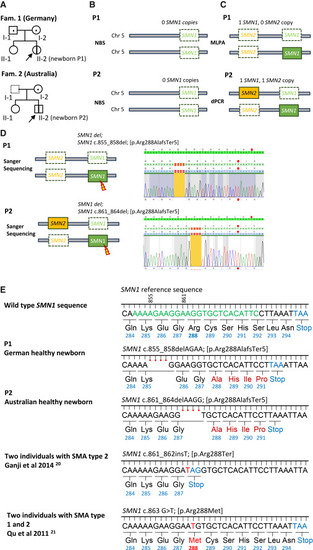
Identification and genetic analysis of two SMN1-VUSs in newborns (A) Pedigrees of the two newborns, P1 and P2. Both were asymptomatic at birth and remained asymptomatic at 2 years of age (indicated by a thick vertical line). The older sisters (II-1) of each newborn were unaffected (open circle). The parents of P1 were carriers (dotted symbols). For P2, the father was unavailable for testing (dashed square), and the mother was a carrier (dotted circle). (B) Schematic representation of SMN1 newborn genetic testing using DNA from dried blood spots (DBSs). No SMN1 signal (blank rectangle) was detected in the SMN1 exon 7 PCR in either newborn: P1 (from Germany) or P2 (from Australia). For P1, the LightMix TREC SMA HBB kit (Roche) was used; for P2, the Eonis SCID-SMA kit (3234-0010) was employed. (C) Schematic representation of confirmatory testing using the MRC-Holland P021 MLPA kit (P1) and multiplexing droplet digital PCR (ddPCR) for P2. Both newborns showed one SMN1 copy (green rectangle). P2 had one SMN2 copy (orange rectangle), while P1 had none (blank rectangle). (D) Schematic representation of the SMA alleles in both newborns. A chromatogram of Sanger sequencing shows the SMN1-VUS (orange block). Deleted nucleotides are marked by small red rectangles. The entire genomic region spanning the SMN1 gene was amplified via long-range PCR (exons 1–8)19 and used as a template to sequence exon 7. A premature stop codon (red dot) is shown in the VUS allele compared to the reference SMN1 sequence. (E) Schematic reference SMN1 exon 7 sequence. NBS primers are indicated in green. Both SMN1-VUSs (4-bp deletion, red dots), altered the C-terminal amino acid sequence (red letters), and premature stop codons are shown. Two additional pathogenic variants from individuals with SMA are included for comparison. |