
Fig. 2
- ID
- ZDB-FIG-250926-23
- Publication
- Rutter et al., 2025 - Retinopathy-associated inosine monophosphate dehydrogenase 1 mutations cause metabolic and filament defects in cones
- Other Figures
- All Figure Page
- Back to All Figure Page
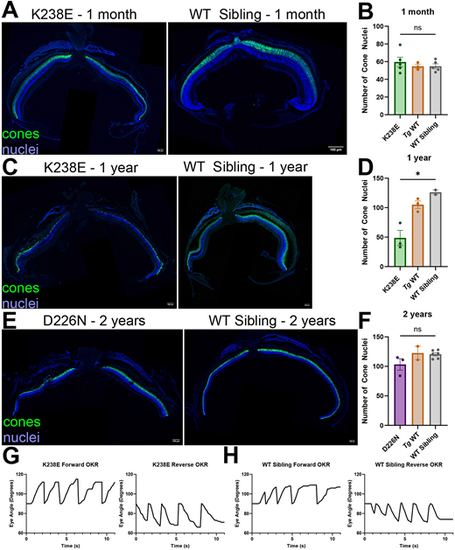
Zebrafish with K238E mutation have severe cone degeneration by 1 year of age, whereas those with D226N mutation do not show significant signs of cone degeneration by 2 years. (A) A 1-month-old zebrafish with K238E mutation (left) shows no signs of degeneration compared to a WT sibling (right). Cone cytosol is in green (gnat2:EGFP with anti-GFP antibody), and nuclei are in blue. Scale bars: 100 µm. (B) Cone nuclei were counted across one-third of the dorsal side of the retina. There was no significant change in cone nuclei for zebrafish with K238E mutation compared with those in WT siblings at 1 month. n=5 for K238E and WT siblings, n=3 for transgenic wild type (Tg WT). ns, not significant (P=0.45) (unpaired two-tailed t-test). Error bars are s.e.m. (C) A zebrafish with K238E mutation has significant cone loss by 1 year of age (left) compared to that in a WT sibling (right). Cone cytosol is in green (gnat2:EGFP with anti-GFP antibody), and nuclei are in blue. Scale bars: 100 µm. (D) Cone nuclei count of zebrafish expressing K238E IMPDH1 mutation or WT siblings. There were significantly fewer cone nuclei in zebrafish expressing K238E impdh1a mutation compared to those in WT siblings. n=3 for K238E and Tg WT, n=2 for WT sibling. *P=0.019 (unpaired two-tailed t-test). Error bars are s.e.m. (E) A 2-year-old zebrafish with D226N mutation (left) shows no signs of degeneration compared to a WT sibling (right). Cone cytosol is in green (gnat2:EGFP with anti-GFP antibody), and nuclei are in blue. Scale bars: 100 µm. (F) Cone nuclei were counted across one-third of the dorsal side of the retina. There was no significant change in cone nuclei for zebrafish with D226N mutation compared with those in WT sibling at 2 years. n=3 for D226N, n=2 for Tg WT and n=6 for WT sibling. ns, not significant (P=0.057) (unpaired two-tailed t-test). Error bars are s.e.m. (G) Optokinetic response (OKR) traces for zebrafish larvae containing K238E impdh1a mutation. Zebrafish larvae have forward (left) and reverse (right) OKR response at 5 dpf. (H) OKR traces for WT siblings to zebrafish larvae containing K238E impdh1a mutation. Zebrafish larvae have forward (left) and reverse (right) OKR response at 5 dpf. |