|
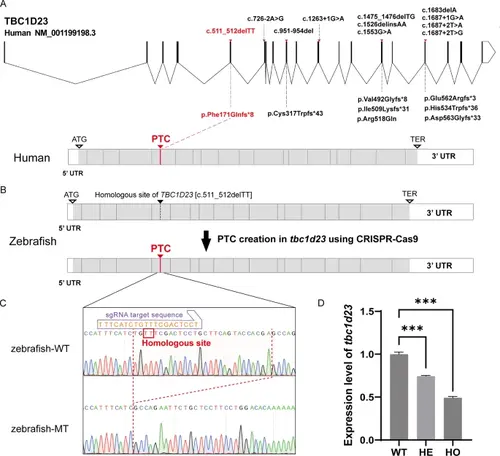
Modeling the human TBC1D23 c.511_512delTT variant in zebrafish reveals evidence of NMD. (A) Schematic of the human TBC1D23 gene. The novel c.511_512delTT variant and resulting PTC (p.F171Qfs*8) are highlighted in red. (B) CRISPR-Cas9 strategy used to create an equivalent frameshift and PTC in the zebrafish tbc1d23 orthologue. (C) Sanger sequencing confirms the indel in mutant (MT) zebrafish. The sgRNA target is boxed (D) qRT-PCR analysis at 3 dpf shows significantly reduced tbc1d23 mRNA levels in heterozygous (HE) and homozygous (HO) mutants compared to wild-type (WT), consistent with NMD activation. Data are mean ± SEM (n = 3); ***P < 0.001 (one-way ANOVA)
|