
Fig. 1
- ID
- ZDB-FIG-250708-57
- Publication
- Chang et al., 2025 - Thallium-induced neurocardiotoxicity in zebrafish: Protective role of adaptive UPR and DNA repair
- Other Figures
- All Figure Page
- Back to All Figure Page
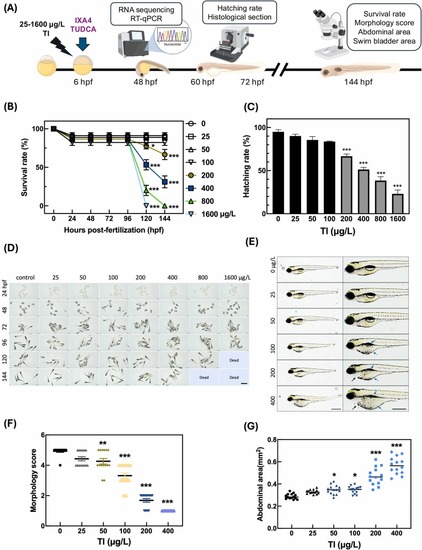
Tl exposure affects zebrafish embryo survival, hatching rate, and morphology.(A) Zebrafish embryos were exposed to various concentrations of Tl (0–1600 μg/L), starting at 6 hpf (hours post-fertilization). Survival rate, hatching rate, morphology, abdominal area, and swim bladder area were observed at multiple time points (48–144 hpf). Transcriptomic analysis was performed at 48 hpf. (B) Survival rates of zebrafish embryos exposed to different Tl concentrations (0–1600 μg/L) over 144 hpf. (C) Hatching rates of zebrafish embryos were assayed at 60 hpf after exposure to Tl (0–1600 μg/L). (D) Representative images of zebrafish embryos and larvae exposed to Tl at different time points (24, 48, 72, 96, 120, and 144 hpf). (E) Representative images of zebrafish larvae at 144 hpf after exposure to Tl (0–400 μg/L). Morphological abnormalities included swim bladder deflation (blue arrows), yolk retention (blue dashed-line arrows), and pericardial edema (black arrows). (F) Morphology scores and (G) abdominal area measurements of the zebrafish larvae. Data are shown as scatter plots representing individual measurements, with horizontal lines indicating the mean of each group (n = 10–15 larvae per group). Statistical significance was determined by one-way ANOVA with post-hoc analysis. *p < 0.05, * *p < 0.01, * **p < 0.001 compared to the control group. Scale bar, 500 µm. |